


Pic Courtesy - UnSplash
The modern startup story is preoccupied with steady progression. We optimize deep-work blocks, drink adaptogenic coffees, track daily metrics, and read memoirs from founders whose most difficult challenges were a single bad fiscal quarter or a damaged ego before a profitable exit. We view operational friction as an abnormality, and market downturns as personal slights from the cosmos. We crumple when a major lead falls through or a co-founder departs after a brief text exchange. We’ve developed a leadership culture based on the idea of ultimate power.
Then we look at the historical, philosophical strategist known as Lord Krishna.
Krishna, unlike the sanitized calendar imagery presenting a motionless deity in continuous tranquility, traveled through a never-ending succession of high-stakes situations. He was not born in a seed-funded incubator, but rather in a maximum-security prison cell. His origins were defined by cold stone, iron chains, and total vulnerability. Prior to his birth, his own kin issued an active death warrant. His early competitive landscape included specific existential threats such as Putana, Shakatasura, Trinavarta, and Kaliya. These were not modest market adjustments; they were direct attempts at complete eradication.
Yet, Krishna remains the archetype of the Purna Purusha—the complete, integrated individual. His distinction lies not in an uninterrupted record of rapid growth and easy victories, but in the fact that continuous adversity never corrupted his internal character. He navigated structural collapse, betrayal, and loss for 125 years without adopting the toxicity of his environment.
For any builder, executive, or innovator operating under extreme market volatility, Krishna offers a rigorous case study in crisis leadership, resilient strategy, and cognitive detachment.
The Pre-Seed Phase: Executing Under an Existential Mandate
Every founder remembers their first launch. You launch the platform, make an announcement, and track real-time stats. If the market reacts silently to the launch, or if a legacy player duplicates the feature set within days, the scenario appears catastrophic.
Krishna’s operational entry took place under significantly harsher conditions. He was born at midnight, during a devastating downpour. Outside, political turmoil erupted under Kamsa, an autocratic ruler who had already brutally murdered six of Krishna’s siblings. Behind his father, Vasudeva, there were sealed gates and armed guards. Ahead lay the swollen Yamuna River.
There was no magical intervention, no guaranteed safe passage, and no sudden surplus of resources. There was only an operator carrying a minimal basket, stepping directly into dark, turbulent waters driven by pure survival mandate.
The Strategic Imperative:
Waiting for optimum conditions before initiating a strategic endeavor is a complete operational blunder. The concept of a “perfect environment” is only present in academic theory. Waiting for market interest rates to normalize, inflation to fall to a specific objective, and personal life to be absolutely calm before executing ensures stagnation throughout the ideation phase.
The conditions at your starting point do not determine your destination. Strategic initiatives can begin with debt, limited networks, and severe incumbent hostility and nonetheless evolve into long-lasting institutions. Destiny does not give smooth runways; instead, execution begins with a step into the river.
Adapting in Exile: Transitioning from Sovereign to Operator
Imagine being prepared from inception to lead a major enterprise, possessing the pedigree, training, and strategic right to the top seat. Then, due to sudden macroeconomic shifts, you are stripped of position and reallocated to a rural, resource-scarce environment to manage basic agricultural labor.
Many leaders spend years mourning lost status, constructing personal narratives of grievance, and refusing to adapt.
Krishna adapted instantly, exhibiting zero operational friction. Born to royalty, he transitioned smoothly into the role of a rural leader in Vrindavan. He did not treat the rural shift as a demotion; he treated it as his core operating environment. He built deep organizational alignment, trust, and loyalty among the local population. He demanded no deference based on past lineage; he built authority through immediate utility, empathy, and presence.
The Adaptability Spectrum:
- Ego-Driven Leader: “My pedigree and background elevate me above low-level execution.”
- Integrated Leader: “Today the requirement is executive oversight; today it is frontline labor. The objective dictates the uniform.”
The environmental threats did not cease in Vrindavan. The hostile regime continued sending disruptions—toxic assets (Putana), chaotic market forces (Trinavarta), and environmental contamination (Kaliya). Continuous black swan events threatened the stability of his group.
Early-stage leaders cannot afford the luxury of ego. High-value execution often requires drafting raw documentation at night, addressing critical support escalations at dawn, and resolving basic facilities issues by afternoon. When sudden industry shifts, talent poaches, or regulatory attacks hit, complaining about systemic unfairness achieves nothing. Markets do not reward sentimentality. The core directive is to neutralize systemic risks—just as Krishna neutralized the toxicity of Kaliya—and keep the organization functional. True leadership converts from grand strategist to frontline operator without losing composure.
Navigating Systemic Loss Without Internal Corruption
Modern business narratives promise that structured effort yields continuous rewards: personal prosperity, continuous public praise, and friction-free exits. Krishna’s trajectory was defined by severe, unavoidable losses.
- Family Separation: Separated from his biological parents immediately upon birth, removing foundational domestic stability.
- Loss of Core Roots: Forced to leave his childhood community of Vrindavan permanently when broader geopolitical duties called him to Mathura.
- Relinquishing Core Relationships: He separated from Radha, the central personal connection of his youth. Strategic responsibility required sacrificing personal attachment for macro-level obligations.
- Socioeconomic Friction: When his childhood friend Sudama arrived in severe poverty, Krishna had to manage the complex balance of personal affection, personal wealth, and the friend’s dignity.
Despite continuous structural stripping of personal comfort, Krishna developed no bitterness or victim complex. He never used past trauma to justify ethical shortcuts or hostile leadership.
Building significant enterprises requires severe personal sacrifice. Leaders frequently lose personal relationships due to constrained time, forgo personal comfort to ensure payroll security for dozens of families, or watch original strategic visions mutate due to market realities.
The primary concern is not loss itself, but the psychological cynicism that can result. Faced with systemic unfairness, many executives become hardened, paranoid, and punitive. Krishna illustrates how to bear intense operational sadness while keeping complete professional compassion. An executive can lose a key product line, a valuable co-founder, or an initial idea while still building a long-lasting business with a clear, unclouded head.
The “Rann chhoree” Strategy: Knowing When to Pivot
One of the most crucial operational lessons for any leader facing an overcapitalized, relentless competitor is knowing when to execute a structural retreat.
Jarasandha, the ruler of Magadha, maintained an absolute obsession with destroying Mathura. He launched seventeen separate massive military campaigns against the city. Seventeen times, Krishna and his allies successfully repelled the forces.
However, before the eighteenth invasion, Krishna examined the long-term balance of human capital and physical resources. Mathura was winning small battles, but losing the overall war. The city’s physical infrastructure had deteriorated, the population was chronically exhausted, and capital was draining at an unsustainable rate. The competition was conducting an efficient attrition campaign.
Before the eighteenth assault, Krishna initiated a move that violated traditional warrior protocols: he withdrew entirely.
He evacuated the population of Mathura and migrated them over a thousand kilometers to Dwarka, an island fortress off the coast of modern Gujarat. For this strategic withdrawal, critics applied the derogatory label Ranchhod—the one who flees the battlefield.
Evaluating the Operational Pivot:
- The Mathura Model (Legacy Market): Continuous high-burn conflict, sunk-cost dynamic, pride-driven defensive posture.
- The Dwarka Model (New Market): Highly defensible island infrastructure, access to international trade routes, long-term operational viability and scale.
In enterprise management, this maneuver is known as a complete strategic pivot. Modern corporate culture frequently glorifies the founder who goes down with a failing asset, competing against better-funded incumbents in a saturated market until cash reserves hit zero. This dynamic confuses ego with resilience.
Your primary commitment belongs to your core mission and your team, not to a specific geographic location, legacy codebase, or outdated product line.
If your present market sector is experiencing a constant war of attrition that depletes team morale and consumes precious capital, continuing in place out of pride is a mistake. Allow competitors to declare cheap victory in public forums. Reallocate your key assets, establish a strong market position, and scale from a place of operational security. Ego requires battling to the death on difficult terrain, while strategy takes a step back to guarantee long-term dominance.
The Compromise Threshold: Resolving High-Stakes Negotiations
Prior to the outbreak of the Kurukshetra war, when opposing forces were mobilized and conflict appeared inevitable, Krishna led a final, rigorous diplomatic intervention. Understanding the immense destruction of full-scale conflict, he traveled directly to the court of Hastinapur as a peace envoy to negotiate with Duryodhana, who held full structural control.
Krishna did not demand the immediate surrender of the entire kingdom for the Pandavas. He systematically scaled down the terms until reaching an absolute Minimum Viable Offer:
“Grant us five villages. One for each brother. Allow them to live as basic citizens, and we will waive all claims to the broader empire.”
Duryodhana’s response reflected classic market overconfidence: “I will not concede enough territory to pierce the point of a single needle.”
Krishna did not react with an emotional outburst or empty threats. He closed the negotiation and exited calmly. The boundaries of reasonable compromise had been established and explicitly rejected. Conflict was now a clear operational necessity.
The Negotiation Framework:
- Initial Position: Claim to full administrative rights across the entire empire.
- Negotiated Floor (MVO): Five villages—minimum functional autonomy to avoid total conflict.
- Counterparty Rejection: Absolute refusal of minimal terms by the incumbent.
- Operational Shift: Termination of dialogue; immediate transition to full-scale strategic disruption.
When negotiating with dominant market players, legacy institutions, or demanding investors, explore every avenue of reasonable alignment first. Avoid conflict driven purely by pride. Show flexibility regarding market share, minor terms, or immediate credit.
However, establish your non-negotiable threshold early. If a counterparty refuses to respect your basic operational autonomy, core intellectual property, or ethical standards, cease endless negotiations. Do not waste energy on endless revisions of intent. Confirm your operational readiness, align your team, and prepare for decisive competition.
Holding the Weight of Scale: Managing the Fallout of Victory
The Kurukshetra war concluded with an absolute victory for the Pandavas. The opposing structure was entirely dismantled. Yet the physical and social cost of that victory was immense.
Historical accounts note that millions perished across the eighteen-day campaign. An entire generation of leadership, technical capability, and youth was erased. The regional economy lay in ruins, and the societal infrastructure was shattered.
Krishna walked through the silent, post-conflict landscape. He held no celebration, demanded no public monuments, and issued no promotional press declarations regarding his strategic triumph. He quietly carried the psychological weight of the outcome.
Then came Gandhari, the grieving mother of the fallen Kaurava leadership. Consumed by grief and anger, she confronted Krishna. She viewed him not as a divine entity, but as the central strategist who possessed the capability to alter the systemic conditions, yet permitted the devastating process to run its full course.
She pronounced a severe curse: that Krishna’s own clan would eventually turn on itself in chaotic internal violence, and that he would meet his end alone in obscurity.
Krishna did not argue. He offered no academic lecture on structural necessity, nor did he remind her of the ethical corruption of her sons. He accepted the tragic consequence of the macro-event with total composure, responding simply with “Tathastu”—May it be so.
The Internal Burden of Scale:
Building an enterprise to massive scale leaves real collateral damage in its wake:
- Reorganizing an enterprise often requires letting go of early employees who trusted the original vision but cannot scale into complex corporate roles.
- Legacy business partners and early adopters may be left behind as the business model shifts toward larger market demands.
- Incumbent competitors may face bankruptcy, impacting their employee bases directly.
Leaders must develop the mental capacity to carry the ethical weight of necessary strategic decisions. Disgruntled stakeholders will criticize your choices, former partners may publicly question your motives, and displaced competitors will attribute their failures to your actions.
Trying to justify every decision to every critic causes operational weariness. True leadership entails taking the burdens and criticisms of your working environment with perfect calm, knowing that your actions helped the long-term survival and essential purpose of the whole system.
The Collapse of the Master Project: Internal System Decay
While the Mahabharata war represented a massive external disruption, the eventual end of Dwarka was a lesson in internal organizational decay.
Thirty-six years after the war, the internal conditions predicted by Gandhari materialized. The Yadavas—Krishna’s own community, executive team, and inner circle—grew arrogant on their accumulated wealth, political power, and long-standing invincibility. Their collapse was not caused by an external competitor or a market shift. They destroyed themselves from within.
During a gathering at Prabhasa, a minor interpersonal dispute escalated rapidly into systemic violence. In the absence of standard weapons, individuals used heavy sea reeds from the shore to attack one another. Within hours, the elite leadership of the Yadava network had eradicated itself in an unmanaged internal conflict.
Krishna’s own son, Pradyumna, fell in the chaotic clash.
Krishna observed the destruction from the shoreline. He did not deploy his primary strategic assets to intervene or arrest the process. He recognized a fundamental law of organizational systems: When the internal culture of an entity experiences total structural rot, external intervention cannot restore its integrity.
Shortly after, the ocean breached the coastline and submerged Dwarka. His primary architectural achievement sank beneath the water, erasing his physical footprint from the region.
The Stages of Organizational Decay:
- Unchecked Scale & Wealth Accumulation: Rapid success removes external pressure, masking underlying structural friction.
- Hubris & Loss of Operational Discipline: Internal standards degrade as teams assume permanent market dominance.
- Fictional Politics & Sub-Group Conflict: Executive teams form internal factions, prioritizing personal standing over the core mission.
- Self-Driven Collapse: The system fails due to internal dysfunction, without requiring a superior competitor.
Every platform, enterprise, and corporate structure maintains a finite lifespan. Companies that dominated global indices decades ago regularly slip into irrelevance or liquidation.
Despite exceptional leadership, internal culture can fracture. Key stakeholders may fight over equity, executive leadership may form political silos, or foundational tech shifts can render an entire product architecture obsolete.
Krishna demonstrates how to observe the dissolution of a major project without suffering a total identity collapse. You are distinct from the organization you build. You are distinct from the platform you manage. If the entity sinks, your core identity remains intact. Accept that certain system lifecycles reach mathematically inevitable conclusions.
The Final Exit: Internal Sovereignty Over Public Praise
How did the foremost strategic mind of antiquity conclude his tenure?
He did not pass away on a golden throne surrounded by advisors, nor did he receive an elaborate state ceremony. He walked quietly into a dense forest, sat beneath an old tree, placed one foot over his knee, and rested in complete solitude.
A passing hunter named Jara mistook his foot for game and released a single iron-tipped arrow. The weapon struck Krishna’s heel.
There was no dramatic public event, no grand speeches, and no heroic exit. There was only a quiet forest, a fatal wound, and absolute silence beneath the canopy.
The Contrast of Exits:
- The Modern Ego Ideal: Multi-billion dollar liquidity events, relentless press profiles, permanent monuments, and endless public praise.
- The Krishna Execution: A quiet forest, an unforeseen minor event, total internal peace, and complete detachment from past achievements.
The individual who restructured the geopolitical architecture of an entire subcontinent exited without reliance on his titles, wealth, or past victories.
Consider your ultimate operational objective: Is it public praise, industry awards, or press coverage? If you build an enterprise primarily for external validation, you build a mental trap for yourself. At the end of a career, after the long hours, strategic conflicts, and capital deployments, the broader world simply moves on. Future generations of leaders will focus on their own immediate challenges, and new frameworks will supersede past accomplishments.
The ultimate objective of a leader is to attain sufficient internal sovereignty so that public acclaim becomes unnecessary. You can step down from your role, hand over control, and meet any transition with total internal stability, knowing you executed your role completely.
The Core Operational Blueprint of the Bhagavad Gita
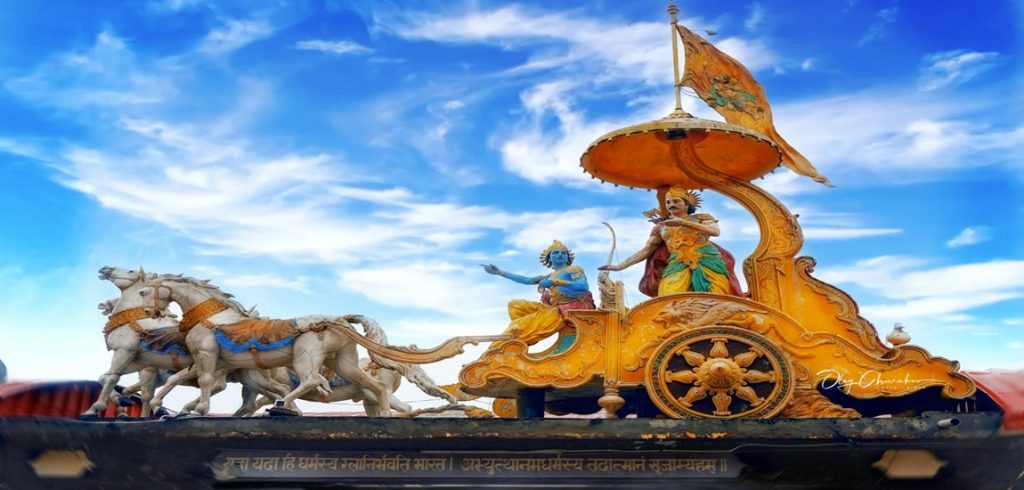
In the center of extreme chaos, positioned directly between two mobilized armies, Krishna delivered one of the most significant operational frameworks ever articulated: the Bhagavad Gita.
He did not counsel Arjuna to escape reality through passive contemplation, nor did he offer superficial, optimistic platitudes. He laid out a precise operational law:

“You have an absolute right to your actions, but you have no baseline right to the fruit of those actions.”
The Operational Equation:

- Inputs: Internal focus, code quality, deal execution, ethical discipline, and daily output.
- Outputs: Macro-market reactions, capital markets, competitor moves, and external validation.
Translated into modern enterprise management, this principle yields two fundamental directives:
1. Detachment Is Not Apathy
Many leaders confuse detachment with a lack of drive, assuming that if they do not control the outcome, effort is meaningless.
Krishna presents the inverse truth: True detachment requires allocating 100% of cognitive energy toward execution and 0% toward anxiety regarding external variables.
When giving a vital presentation or negotiating with a big partner, if you are worried with fear of failure, financial inadequacies, or personal reputation, you are wasting valuable mental bandwidth on variables outside your immediate control. Treat the presentation solely as your responsibility. Execute with utmost precision. Once accomplished, take a step back and let external variables align as they will.
2. Maintaining Stability in Adverse Environments
Sustaining an encouraging culture when revenue increases rapidly and funding is abundant requires minimal effort. Any manager can project confidence during an economic expansion.
The true evaluation of leadership occurs when operational conditions fail completely.
When critical systems crash, cash flow tightens unexpectedly, or a key client terminates a contract, a weak leader turns volatile, projecting panic onto their team. An integrated leader adjusts their strategy, evaluates the landscape calmly, and continues operating without fear.
Krishna maintains his composure because he understands a basic truth: External chaos cannot disrupt internal stability unless a leader yields control.
The Executive Mandate
For any leader operating through complex challenges:
- If your capital structure is constrained… remember the stone walls of the prison cell.
- If competitors launch continuous aggressive campaigns… remember Putana, Trinavarta, and Kaliya.
- If you must sunset a core product line and pivot your team… apply the Ranchhod strategy and construct your Dwarka.
- If your industry faces severe structural downturns… stand like Krishna on the chariot—focused, uncorrupted, and clear-headed.
Do not ask for a journey free of friction. Do not expect an operational path lacking betrayal, market shifts, or systemic failures.
Instead, execute according to the blueprint of the Purna Purusha.
When life presented Krishna with extreme constraints, he responded with strategic clarity. When confronted with betrayal, he responded with the Gita. When surrounded by war, he responded with detachment.
Evaluate your current environment, process the operational noise, and execute your core strategy with total focus.



More Blogs
Navigating Industry Ignorance !
Startup & Maintaining Morale: Navigating the Rollercoaster of Growth
Life’s Real Problems: 7 Hidden Barriers