



Pic courtesy - Unsplash
Launching and building a firm is one of the most rewarding and challenging journeys an entrepreneur can take. The pleasure of creating something out of nothing is thrilling, but repeated setbacks, financial hardship, operational friction, and the persistent pressure to deliver growth can deplete even the most dedicated founders.
Motivation in the early phases of a firm is rarely a constant emotional state. It varies significantly with pitch results, product launches, customer turnover, and runway data. For a founder, losing momentum is risky, but losing personal motivation is deadly. When a founder’s conviction wavers, team morale suffers, investor confidence dwindles, and strategic direction fails.
Deep, resilient motivation demands intentional mental models, operational protections, and strategic discipline. High-performing entrepreneurs don’t rely on fleeting excitement; instead, they create mechanisms that preserve their energy and reinforce their focus.
The following are six basic tactics utilized by world-class founders to retain psychological endurance and motivation, along with real-world case studies that demonstrate how these ideas worked in practice.
1. Surround Yourself with a Supportive Network
Entrepreneurship is fundamentally solitary. Founders spend their days carrying the weight of high-stakes decisions, dealing with the worry of short runway, and demonstrating unwavering confidence to employes, customers, and investors. Internal expressions of uncertainty or vulnerability can upset a team, leaving founders with limited options for dealing with their own anxieties or stress.
Surrounding yourself with an intentional network of peers, advisors, and fellow founders creates a vital psychological shock absorber. A strong founder network serves two distinct purposes:
- Emotional Calibration: Realizing that other high-growth founders face near-identical operational crises, cash flow panics, and board friction normalizes the turbulence of the startup lifecycle. It replaces isolation with perspective.
- Strategic Pressure Testing: Peer groups and founder cohorts challenge blind spots, validate critical hypotheses, and provide candid feedback that internal teams may be hesitant to deliver.
Building this network requires proactive effort. It means joining high-caliber accelerator ecosystems, founder masterminds, or sector-specific peer groups where psychological safety is prioritized over posturing.
Real Business Case Study: Airbnb and the Power of the Y Combinator Cohort
In early 2009, Airbnb (then AirBed & Breakfast) was struggling to secure traction and surviving on maxed-out credit cards and novelty cereal sales (Obama O’s). Founders Brian Chesky, Joe Gebbia, and Nathan Blecharczyk were physically exhausted and mentally drained. They were working out of their apartment, rejected by virtually every venture capitalist in Silicon Valley, and questioning whether their concept of letting strangers sleep in other people’s homes was viable.
The turning point for their motivation and trajectory came when they joined Y Combinator (YC) in the Winter 2009 batch. Beyond the seed funding and Paul Graham’s direct guidance, the defining catalyst was the peer network.
Surrounded by other founders working 100-hour weeks, experiencing near-daily rejections, and battling their own operational fires, Chesky and his team found a community where their struggle was understood. During YC’s weekly dinners, founders shared raw metrics, failures, and tactics without the filter required when presenting to external investors.
This network reignited the team’s drive. When Paul Graham gave them the iconic, high-friction advice to “go to your users in New York,” the accountability and collective energy of the cohort pushed Chesky and Gebbia to board a plane to New York City immediately. They knocked on doors, photographed listings, and spent time directly with their early hosts. The psychological backing and relentless standards of their peer community turned Airbnb’s despair into an operational routine that eventually unlocked product-market fit.
2. Revisit Your Vision
It is simple for founders to develop tactical myopia when they are engrossed in the day-to-day operations of a company, such as handling payroll, resolving customer support issues, troubleshooting product releases, and negotiating vendor terms. The overarching goal that initially motivated the endeavor is obscured by the immediate stress of implementation.
Motivation wanes when performance gets tedious or overpowering. Successful founders deliberately distance themselves from tactical firefighting in order to reexamine their fundamental principles in order to combat this.
A well-articulated vision functions as a North Star:
- It provides context to present suffering by framing current operational pain as a necessary cost of long-term transformation.
- It aligns long-term strategy, keeping the team focused on fundamental outcomes rather than short-term distractions.
- It reignites intrinsic passion, reminding the founder why the problem is worth solving.
Revisiting a vision is not merely a passive exercise in optimism. It requires setting aside structured time—quarterly offsites, monthly deep-think days, or written reflection—to evaluate whether current operations still serve the overarching mission.
Real Business Case Study: SpaceX and the Mission to Make Humanity Multi-Planetary
In 2008, SpaceX was on the brink of complete collapse. The company’s first three launches of the Falcon 1 rocket had failed, exploding before reaching orbit. Hundreds of millions of dollars of capital had been consumed, key talent was burnt out, and media commentators widely ridiculed the company’s ambitions. Elon Musk was simultaneously facing acute financial distress at Tesla and navigating a high-profile personal divorce.
By the fourth launch, SpaceX had barely enough capital and salvaged components to assemble one final rocket. The pressure on Musk and his engineering team was overwhelming; a fourth failure meant total liquidation.
What sustained Musk’s drive during this period was a commitment to the foundational vision of SpaceX: making life multi-planetary by radically reducing space transportation costs. Musk did not view SpaceX merely as a commercial launch provider attempting to capture satellite deployment contracts. He viewed it as a necessary vehicle to preserve the future of human consciousness.
In team all-hands meetings and private engineering reviews leading up to the fourth launch, Musk consistently anchored every operational detail back to this mission. On September 28, 2008, Falcon 1 Flight 4 successfully achieved orbit, becoming the first privately-developed liquid-fuel rocket to do so. The clarity of the mission gave the leadership team and core engineers the psychological endurance required to work through three catastrophic failures without losing operational focus.
3. Plan for Challenging Times
First-time founders frequently fall into the trap of assuming that progress would be linear. The gap between expectations and reality causes significant psychological strain when unforeseen challenges arise, such as product delays, key employe exits, or slow sales cycles.
Instead than assuming everything will go smoothly, resilient entrepreneurs create a culture of operational readiness. Founders develop organizational and emotional resilience by foreseeing structural obstacles and realizing that hardship is a fundamental aspect of the startup process.
Planning for challenging times involves:
- Normalizing Friction: Accepting that product-market fit decays, key employees will leave, and competitors will copy features. Expecting these events eliminates the shock when they occur.
- Building Personal and Financial Buffers: Maintaining individual physical wellness, personal financial discipline, and extended company capital runways to avoid operating under perpetual panic.
- Cultivating Growth Mindsets: Framing every structural failure as an engineering problem to be analyzed, dissected, and solved rather than a personal defeat.
Real Business Case Study: Nvidia’s Near-Bankruptcy and the Pivot to RIVA 128
Long before Nvidia became a multi-trillion-dollar artificial intelligence hardware titan, the company faced a existential crisis that nearly wiped it out in 1996. Founded by Jensen Huang, Chris Malachowsky, and Curtis Priem, Nvidia’s first graphics chip, the NV1, was a commercial failure. The company had bet on quadrilinear texture mapping, but Microsoft announced Direct3D, making triangle-based rendering the universal industry standard.
Nvidia found itself with a product nobody wanted, a rapidly shrinking cash runway, and a workforce demoralized by an obsolete technology roadmap. Jensen Huang realized the company had less than six months of cash remaining.
Instead of panicking or abandoning the business, Huang planned for extreme austerity and restructured the entire engineering process. He knew that to survive, Nvidia had to build a completely new graphics architecture (the NV3, later named RIVA 128) using the triangle-based rendering standard, and it had to work on the very first silicon spin because the company could not afford a second manufacturing run.
Huang prepared his team for intense difficulty. He famously adopted the motto, “Our company is 30 days away from going out of business,” not to induce panic, but to instill a culture of rigorous precision, resourcefulness, and focus. He downsized the company to retain only core talent, secured a crucial bridging relationship with TSMC, and shifted engineering validation entirely to software simulation before manufacturing.
When the RIVA 128 launched in 1997, it was a massive success, selling over one million units in four months. Huang’s anticipation of crisis and structured preparation turned an impending bankruptcy into the foundation of modern GPU computing.
4. Make Contingency Plans
While preparing for difficult times increases overall resilience, creating clear backup plans enables a founder to make a quick decision in the face of extreme operational stress. When unanticipated external shocks occur, such as a pandemic, an abrupt change in regulations, or the loss of a significant distribution partner, founders without backup plans frequently freeze, paralyzed by the loss of their main strategy.
Contingency planning is the practice of systematically asking, “What do we do if our core assumptions are completely wrong?”
Having actionable Plan B and Plan C scenarios preserves a founder’s motivation in three distinct ways:
- Maintains Agency: It transforms a crisis from an overwhelming threat into an execution challenge with predefined steps.
- Protects Runway: Pre-calculated contingency triggers (e.g., “If revenue drops by 30%, we execute cost-reduction Scenario B immediately”) prevent slow, indecisive burn rates that bankrupt startups.
- Unlocks Optionality: Many of the world’s most successful companies were created when founders executed a contingency pivot after their original business model failed.
Real Business Case Study: Slack Born Out of Tiny Speck’s Failed Game
In 2009, Stewart Butterfield—co-founder of Flickr—launched a company called Tiny Speck to build a web-based, non-violent massively multiplayer online game named Glitch. The team raised significant venture capital, hired world-class developers and artists, and spent over three years building a deeply imaginative virtual world.
However, upon launch in late 2011, it became clear that Glitch was too niche to achieve the massive user scale required to support its operational costs. The core product hypothesis was failing.
Instead of letting the slow death of Glitch erode his motivation and exhaust the company’s remaining capital, Butterfield activated a contingency mindset. He audited the internal tools and assets the company had built while developing the game. During their years of remote, distributed development across San Francisco and Vancouver, the Tiny Speck team had built an internal, IRC-based messaging system to communicate, share code, and archive files.
Butterfield realized that while the game was not viable, the communications system they built to make the game was extraordinary. He made the deliberate choice to shut down Glitch while the company still had cash in the bank, returned capital to investors who wanted it, and pivoted 100% of the team’s resources into building an enterprise communication platform.
That internal contingency tool became Slack. Launched publicly in 2014, Slack became one of the fastest-growing business software applications in history, culminating in its acquisition by Salesforce for $27.7 billion in 2021. Butterfield’s willingness to execute a radical contingency strategy preserved his vision and delivered an exceptional outcome.
5. Read & Learn Regularly
As a startup expands, the responsibilities placed on its founder change quickly. The abilities needed to grow a business from $1 million to $50 million (management, delegation, organizational design, capital allocation) are essentially different from those needed to grow it from zero to $1 million in revenue (ideation, scrappy product creation, direct sales).
When founders reach a growth ceiling, it’s usually because the company’s growth curve has outpaced their own. Burnout, dissatisfaction, and a feeling of stress are symptoms of this skill mismatch. The key to avoiding this plateau is ongoing, systematic learning.
High-performing founders view learning as an essential professional duty. Reading history, business biographies, management frameworks, and technical literature provides crucial advantages:
- Framework Acquisition: Books and long-form study provide structured models for solving complex organizational and strategic problems without needing to invent every solution from scratch.
- Historical Perspective: Reading about historic corporate battles, technological shifts, and past economic cycles demonstrates that current challenges are rarely unique, reducing anxiety and improving decision-making.
- Mental Disconnection: Engaging deeply with dense, non-reactive material slows down cognitive processing, offering a rest from the hyper-reactive, notification-driven cadence of daily founder life.
Real Business Case Study: Patrick Collison and the Intellectual Culture of Stripe
Patrick Collison, co-founder and CEO of Stripe, has built one of the most valuable private technology companies in the world. From Stripe’s inception, Collison has maintained an extraordinary personal reading and learning discipline, which has directly shaped Stripe’s corporate strategy and culture.
Collison is known for carrying books wherever he goes and maintaining a personal website cataloging hundreds of books across history, physics, economics, software engineering, and biography. Rather than relying solely on Silicon Valley startup playbooks, Collison studies historical industrial transformations, such as the growth of the early American railroad system, the operational management of Bell Labs, and the organizational structures of 20th-century manufacturing leaders.
This commitment to continuous learning protected Collison from the operational traps that defeat many young CEOs. When Stripe began expanding globally, Collison studied international financial infrastructure, regulatory frameworks, and economic history to build software designed for multi-decade durability.
Furthermore, Collison embedded this learning culture into Stripe’s operational DNA. The company encourages employees to purchase any book that will aid their professional development, maintains internal libraries, and emphasizes clear, long-form written memos over slide decks—a practice directly inspired by Collison’s reading of corporate history. This continuous intellectual renewal has kept Stripe’s leadership team adaptive and highly motivated across more than a decade of explosive growth.
6. Seek Mentorship
Experienced mentors offer strategic insight, while peer networks provide tactical input and emotional support. A mentor is someone who has successfully navigated the same terrain as a founder. They have successfully negotiated exits, endured economic downturns, grown companies thru hypergrowth, and handled board disagreements.
It is slow, expensive, and intellectually taxing to try to solve every new founding problem by trial and error. By actively seeking mentorship, entrepreneurs can take advantage of outside expertise, preventing expensive errors and hastening their expansion.
Mentorship aids founder motivation by:
- Short-Cutting Decision Cycles: A 30-minute conversation with a mentor who has faced a similar situation can resolve weeks of agonizing over complex decisions.
- Providing Unfiltered Accountability: Great mentors hold founders accountable to their highest goals, refusing to accept excuses or short-term rationalizations.
- Offering Objective Perspective: During an intense crisis, a mentor remains unattached to the immediate emotion of the situation, offering clear, rational guidance.
Finding effective mentorship requires intentionality. The most valuable relationships are built on specific operational questions, deep mutual respect, and a commitment by the founder to execute on advice and report back on results.
Real Business Case Study: Mark Zuckerberg and Steve Jobs
In 2006, Facebook (now Meta) was just two years old, but it was growing at a staggering rate. Mark Zuckerberg, then only 22 years old, faced intense pressure from his executive team and board of directors to sell the company to Yahoo! for $1 billion.
Zuckerberg felt deep internal conflict. Virtually everyone around him argued that taking the $1 billion payout was the rational choice. His core management team was fracturing over the decision; key leaders wanted to take the deal, and many ended up leaving when Zuckerberg refused to sell. The burden of standing alone against his investors, executives, and the tech press created intense psychological strain and eroded his confidence in leading the company.
During this period, Zuckerberg sought out Steve Jobs for mentorship. Jobs, who had navigated severe crises at Apple and Pixar, mentored the young CEO on how to maintain independence, build a company designed for the long term, and preserve product integrity.
When Zuckerberg was unsure how to re-align his team around Facebook’s core mission, Jobs recommended that Zuckerberg visit a specific temple in India that Jobs had visited early in his own life when seeking clarity on Apple’s mission. Zuckerberg took the trip, spending a month reflecting on the long-term impact of connecting the world.
Upon his return, Zuckerberg’s conviction was completely restored. Backed by Jobs’ continued guidance on product focus and executive management, Zuckerberg declined the $1 billion offer and restructured Facebook’s corporate governance to maintain founder control. That mentorship moment proved pivotal, enabling Facebook to grow into one of the most dominant enterprises in modern history.
Sustaining Motivation as an Operational Discipline
As a startup creator, maintaining motivation doesn’t mean waiting for inspiration to come or depending just on willpower. Under constant stress, willpower is a limited resource that eventually deteriorates. Rather, long-term motivation needs to be viewed as an operational discipline—a system based on particular mental models, networks, and habits.
You create a long-lasting foundation for success by surrounding yourself with a network of support, regularly reviewing your North Star vision, anticipating systemic challenges, keeping adaptable backup plans, committing to lifelong learning, and seeking advice from seasoned mentors.
The startup process is often a prolonged endurance test rather than a smooth sprint. Successful founders are those who create the mechanisms required to maintain motivation, adjust under duress, and stay in the game long enough to win—not those who never feel uncertainty, exhaustion, or failure.



More Blogs
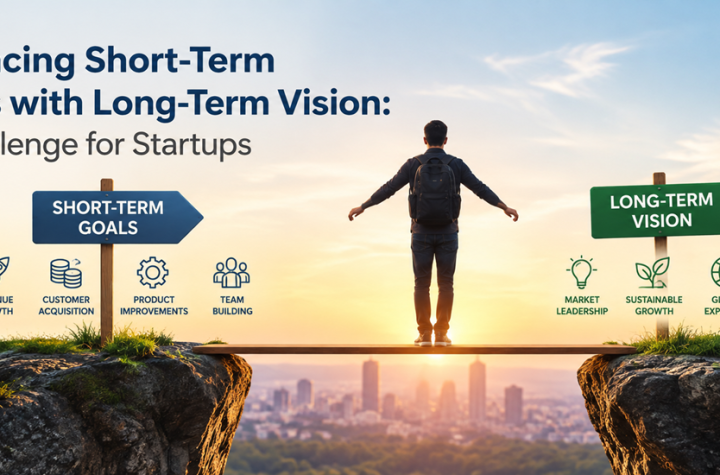
Balancing Short-Term Goals with Long-Term Vision !
Adapting to Change: A Challenge for Startups
Accessing New Markets: A Challenge for Startups