


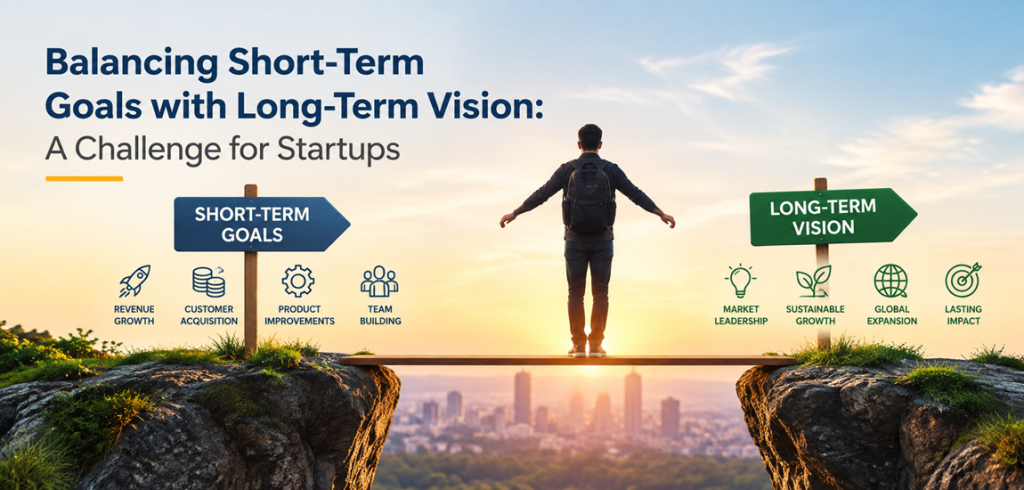
Pic Made by AI
Startups operate in a volatile, complex, and fast-paced environment. On any given Tuesday, a founder could face a server failure, a critical enterprise client threatening to leave, an urgent payroll shortage, or an aggressive competitor unveiling a copycat product. In the midst of this operational upheaval, it is all too easy to lose sight of the transformational, multibillion-dollar ambition that drove the company’s existence in the first place.
This daily tension forms the central dilemma of startup leadership: how to survive the relentless, hyper-urgent demands of today without mortgaging the scalable, category-defining promise of tomorrow.
Short-term execution powers the engine. It generates cash flow, validates product-market fit, keeps the lights on, and reassures investors that the company is still active and growing. However, long-term strategy determines the vehicle’s route and destination. It develops persistent competitive moats, establishes strong brand equity, and unleashes exponentiated enterprise value. Prioritizing short-term survival over long-term vision fosters a reactive consultant mindset—a business that survives month after month but never reaches enterprise scale. Obsessing over a great ten-year goal while neglecting immediate financial realities, on the other hand, is a surefire way to go bankrupt.
To build an enduring company, founders must learn to master both speeds simultaneously. This masterclass blog breaks down the four core pillars of balancing immediate operational execution with long-term strategic vision, complete with real-world business case studies illustrating how iconic technology startups navigated these exact trade-offs.
1. Prioritization: The Key to Strategic Growth
The greatest resource restriction for any company is not funds, but focus. Every week, founders are flooded with hundreds of new possibilities, features, and operational fires. Strategic growth necessitates a rigorous approach to triage, ensuring that current flames are quenched without jeopardizing future expansion.
Setting Priorities Based on Urgency and Importance
A foundational tool for startup leaders navigating this chaos is the Eisenhower Matrix, adapted specifically for high-growth tech environments:
- Urgent & Important (Do First): Core operational crises that directly impact survival, core customer retention, or critical cash runway. Examples include major service outages, game-breaking product bugs, critical legal compliance issues, or managing run-out dates on cash flow.
- Important but Not Urgent (Schedule & Protect): The foundational investments that compound in value over time. Examples include building a scalable technical architecture, defining brand positioning, developing employee training, conducting foundational customer research, and launching strategic R&D projects.
- Urgent but Not Important (Delegate or Automate): Time-sensitive tasks that demand attention but do not alter the trajectory of the company. Examples include routine administrative requests, vendor inquiries, non-strategic partner calls, and low-level operational maintenance.
- Neither Urgent Nor Important (Eliminate): Vanity metrics, vanity PR opportunities, speculative side features without customer demand, and endless exploratory meetings without clear agendas.
Actionable Execution Frameworks
To translate this prioritization matrix into real-world momentum, startups must implement concrete management frameworks:
- Define North Star Metrics (NSM): Every startup needs a clear, overarching metric that links short-term performance to long-term value creation. Spotify uses “Time Spent Listening”; Airbnb uses “Nights Booked.” A well-chosen North Star Metric prevents short-term growth hacks (like spamming users with push notifications) from destroying long-term retention and trust.
- Rank Initiatives Using RICE Scoring: Before committing engineering or marketing resources, evaluate every project against Reach, Impact, Confidence, and Effort. This removes subjective bias and forces the team to balance low-effort short-term wins against high-impact long-term bets.
- Implement the 70-20-10 Resource Allocation Model:
- 70% of Effort on Core Operations: Immediate revenue generation, core product improvements, bug fixes, and servicing existing paying customers.
- 20% of Effort on Adjacent Growth: Near-term expansions, entering adjacent customer segments, building key integrations, or optimizing sales funnels.
- 10% of Effort on Moonshots: Speculative, highly innovative long-term projects that could redefine the market or unlock entirely new business models if successful.
Real Business Case Study: Stripe
In its early days (2010–2011), Stripe was competing in a payments landscape dominated by traditional merchant acquirers and legacy platforms like PayPal. The immediate operational temptation for Stripe was to build heavy, complex sales teams to sign up large merchants through custom, manual onboarding processes—a short-term revenue strategy that many fintech incumbents urged them to pursue.
However, founders Patrick and John Collison recognized that their long-term vision was to build the “economic infrastructure for the internet.” They used strict prioritization to balance immediate survival with this multi-decade vision.
Short-Term Execution
To address the immediate operational need for revenue and developer feedback, Stripe launched “Collison Installation.” Whenever a developer showed interest in Stripe, the founders didn’t just send a link; they took the developer’s laptop on the spot and installed the code inline. This provided immediate user acquisition, instant feedback on API bugs, and rapid validation of their core product.
Long-Term Alignment
Simultaneously, Stripe refused short-term enterprise custom deals that required modifying their core codebase into fragmented, custom installations. They spent 70% of their engineering resources perfecting seven simple lines of code that any developer could copy and paste into a site. They deliberately traded away immediate, custom enterprise revenue in exchange for building an extraordinarily elegant, scalable API infrastructure.
The Result
By prioritizing developer experience and API scalability (Important but Not Urgent) over custom enterprise deals (Urgent for cash flow), Stripe built a developer-first platform that spread virally. Today, Stripe powers millions of businesses globally and is valued in the tens of billions of dollars. Their strict refusal to compromise core architecture for short-term revenue spikes created an unassailable moat in financial software infrastructure.
2. Taking Up Initiatives That Align with Long-Term Vision
“Shiny object syndrome” is a traditional failure mode for early-stage firms, which involves chasing immediate revenue or press attention by taking on ventures that move the company away from its initial objective. Sustainable growth necessitates implementing activities that produce near-term momentum while also moving the company closer to its ultimate long-term goal.
Core Strategic Pillars for Long-Term Alignment
- Product Development: Avoiding temporary, quick-fix hacks in favor of building scalable, modular architecture. While a quick-and-dirty database fix might solve today’s load spike, investing in a robust, automated infrastructure ensures the platform can handle 100x growth without collapsing.
- Brand Building: Resisting toxic short-term marketing tactics (such as aggressive clickbait, misleading discounts, or dark-pattern subscriptions) in favor of genuine thought leadership, community building, and brand equity.
- Customer Retention & Lifetime Value (LTV): Prioritizing customer success and organic retention over hyper-aggressive customer acquisition campaigns. Acquiring one customer who stays for five years is exponentially more valuable than acquiring ten customers who churn after thirty days.
Real Business Case Study: Amazon Web Services (AWS)
In the mid-2000s, Amazon was primarily known as an e-commerce giant operating on thin margins. Inside the company, however, engineers were building internal tooling to make Amazon’s IT infrastructure modular and decoupled, allowing internal software teams to build applications faster without waiting for server provisioning.
Chief Executive Officer Jeff Bezos and executive Andy Jassy recognized an extraordinary opportunity: they could turn this internal infrastructure into an external cloud computing product.
Short-Term Pressure
At the time, Wall Street was relentlessly pressuring Amazon to focus exclusively on its retail margins, cut capital expenditures, and squeeze short-term profitability out of its e-commerce business. Building a cloud infrastructure business required massive capital investments in data centers, network fiber, and specialized engineering talent—spending billions of dollars on a business model that had no precedent in corporate history.
Long-Term Strategic Initiative
Rather than capitulating to short-term investor demands for immediate margin expansion, Amazon doubled down on AWS. They structured AWS as a utility service, offering computing power at remarkably low, pay-as-you-go prices. This aligned perfectly with Amazon’s overarching long-term vision: being an infrastructure platform that enabled millions of businesses to operate.
The Result
AWS essentially invented modern cloud computing. By investing heavily in scalable cloud infrastructure long before the market demanded it, Amazon transformed AWS into the engine of the entire company’s profitability. Today, AWS accounts for the vast majority of Amazon’s total operating income, generating tens of billions in high-margin revenue and powering a significant portion of the global internet.
3. Addressing Immediate Needs Without Losing Sight of Vision
Every company faces unanticipated, high-risk operational constraints, such as funding freezes, supply chain problems, regulatory policy revisions, or severe macroeconomic downturns. Handling these acute situations without jeopardizing the long-term plan demands strategic thinking, operational agility, and disciplined execution.
Tactical Frameworks for Managing Pressing Needs
- Iterative Minimum Viable Products (MVPs): When forced to respond to an urgent market change or customer request, launch the absolute minimal operational version of the solution first. Test demand and gather real usage data before committing months of engineering capacity to a full-scale build.
- Strategic Partnerships: Instead of burning capital and time to build peripheral capabilities in-house during an operational squeeze, partner with existing platforms to fill the gap.
- Contingency Financial Planning: Maintain clear capital triggers. Define dynamic expense plans that automatically adjust based on cash runway indicators, ensuring the team is never forced into panic sales or destructive equity liquidations during unexpected market contractions.
Real Business Case Study: Airbnb
In late 2008, Airbnb (then AirBed & Breakfast) was facing a catastrophic existential crisis. The global economy was collapsing into the Great Recession, venture capital funding had completely dried up, and the startup was running out of cash. The founders—Brian Chesky, Joe Gebbia, and Nathan Blecharczyk—were buried under thousands of dollars in personal credit card debt, and the platform was generating less than $200 a week in revenue.
The immediate, pressing need was plain: immediate cash survival.
Addressing the Short-Term Need
To keep the company alive without giving up equity or compromising their long-term vision of a global peer-to-peer travel platform, the founders got creative. During the 2008 Democratic National Convention in Denver, they bought bulk quantities of plain cereal, designed custom political cereal boxes featuring “Obama O’s” and “Cap’n McCain’s,” manually assembled them in their kitchen, and sold them as limited-edition collector’s items at $40 per box.
They raised over $30,000 in pure cash profit through cereal sales—funding their basic living expenses and server costs for crucial additional months.
Protecting the Long-Term Vision
Importantly, they did not pivot into becoming a political novelty marketing agency or a custom package design firm. They used the cereal money purely as a non-dilutive, short-term cash runway bridge to keep working on their core platform. During this bought time, they applied to Y Combinator, refined their host onboarding flow, personally traveled to New York to take professional photos of host listings, and built the foundation for their global marketplace.
The Result
By creatively solving their immediate financial emergency through non-traditional short-term tactics, Airbnb survived the 2008 recession without abandoning its long-term vision. Today, Airbnb is a global hospitality giant listed on the public markets with a market capitalization spanning tens of billions of dollars.
4. Keeping an Action Flow for Both Goals
To prevent short-term tasks and long-term vision from operating as competing forces, high-performing startups embed both into a unified, structured operational cadence. A continuous action flow ensures that daily execution feeds directly into multi-year strategic objectives.
Integrated Dual-Track Operational Architecture
[ Short-Term Action Flow ]
1. Identify Urgent Need (Customer issue, cash constraint, operational bug)
2. Strategic Alignment Check (Does the fix violate core principles or architecture?)
3. Execute Minimum Viable Solution (Speed + pragmatic containment)
4. Feedback Loop & Data Collection (Measure results and document technical debt)
│
▼
[ Long-Term Action Flow ]
1. Define Ultimate Vision & North Star (Multi-year market transformation)
2. Deconstruct into Strategic Phases (Annual strategic pillars & quarterly OKRs)
3. Allocate Resources (70-20-10 allocation rule)
4. Measure, Refine & Pivot (Iterative strategy updates based on short-term data)
Short-Term Execution Flow
- Identify Urgent Operational Needs: Monitor daily customer issues, pipeline bottlenecks, and platform stability metrics.
- Strategic Alignment Check: Assess proposed quick fixes against core company values and long-term architecture. Ask: Does this quick fix create unmanageable technical or operational debt?
- Execute Rapid Solutions: Deploy minimum viable solutions that resolve the immediate issue without locking the platform into unsustainable legacy systems.
- Feedback & Integration: Gather operational data from the short-term response and feed these insights into the long-term product engineering queue.
Long-Term Strategic Flow
- Define Multi-Year Vision: Establish a clear 3-to-5-year picture of the market transformation the startup aims to lead.
- Deconstruct into Phased Milestones: Break the long-term vision down into annual themes and quarterly Objectives and Key Results (OKRs).
- Resource Allocation: Dynamically balance engineering, marketing, and operational capital across the 70-20-10 distribution framework.
- Continuous Strategy Review: Hold quarterly strategic reviews to compare short-term market feedback against long-term assumptions, adjusting the strategic roadmap as real-world market dynamics evolve.
Real Business Case Study: Netflix
Netflix’s transformation over three decades is perhaps the most extraordinary corporate example of executing a structured action flow that balances immediate operational revenue with a radical long-term vision.
Founded in 1997 by Reed Hastings and Marc Randolph, Netflix began as a DVD-by-mail rental service. However, Hastings’ ultimate vision was never to run a logistics network for physical media; the company was deliberately named Netflix because the long-term vision was always to stream video directly over the internet.
Executing the Dual-Track Action Flow
Throughout the late 1990s and early 2000s, video streaming technology was completely unviable due to slow dial-up internet speeds and limited bandwidth infrastructure.
- Short-Term Flow Execution: Netflix focused intensely on optimizing its physical DVD subscription engine. They pioneered the no-late-fee subscription model, built an automated network of nationwide distribution centers, and perfected a personal recommendation engine (Cinematch) to maximize customer satisfaction and recurring cash flow.
- Long-Term Flow Integration: While generating 100% of its revenue from DVD rentals, Netflix continually invested a portion of its profits into R&D for video compression, content delivery network architecture, and streaming interfaces. They waited patiently for broadband penetration to reach a critical threshold.
When broadband internet speeds finally matured around 2007, Netflix launched its digital streaming service as a free add-on for existing DVD subscribers. They progressively shifted engineering talent and marketing budgets away from DVDs and into streaming infrastructure. Later, when media licensing costs began to skyrocket, they executed another long-term strategic shift: producing original content (House of Cards in 2013), transforming Netflix from a distribution channel into a world-class media studio.
The Result
By maintaining a rigorous, dual-track action flow, Netflix systematically migrated its entire business model twice—first from physical DVD delivery to digital streaming, and second from content licensing to original studio production. By using short-term DVD profits to fund long-term streaming technology, Netflix dominated entertainment streaming globally while legacy competitors like Blockbuster collapsed into bankruptcy.
The Balance is the key !
Balancing short-term operational execution with a long-term strategic vision is not a one-time exercise or a static milestone; it is an ongoing management discipline that lasts for the entire lifecycle of a startup.
Founders who focus exclusively on short-term tasks build reactive businesses that get trapped on a transactional treadmill—constantly working to survive the week, but ultimately vulnerable to disruption by visionary competitors. On the flip side, founders who remain head-in-the-clouds with a grand ten-year strategy while ignoring daily customer feedback and operational cash flow routinely go out of business long before their vision ever gets a chance to materialize.
To navigate this delicate balance and build an enduring company, startup leaders must execute on four core operational principles:
- Prioritize Rigorously: Deploy structural frameworks like the Eisenhower Matrix, North Star Metrics, and the 70-20-10 resource allocation model to protect strategic growth from being overwhelmed by daily fires.
- Align Initiatives with Core Mission: Choose product, brand, and customer retention initiatives that solve immediate operational needs while simultaneously laying down the foundation for scalable, multi-decade growth.
- Address Crisis Creatively: Resolve immediate capital and operational shortfalls using creative, non-dilutive, and agile methods without compromising core principles or pivoting away from the ultimate target.
- Maintain Integrated Workflows: Build operational cadences like quarterly OKRs and continuous feedback loops that continuously feed short-term execution insights directly into long-term strategic planning.
By embedding these strategies into the daily culture of the enterprise, startup founders can bridge the gap between today’s operational realities and tomorrow’s transformative vision—ensuring immediate survival while laying the groundwork for sustainable, category-defining success.



More Blogs
Adapting to Change: A Challenge for Startups
Accessing New Markets: A Challenge for Startups
Sustaining a Startup Founder’s Motivation