


Pic - AI Generated
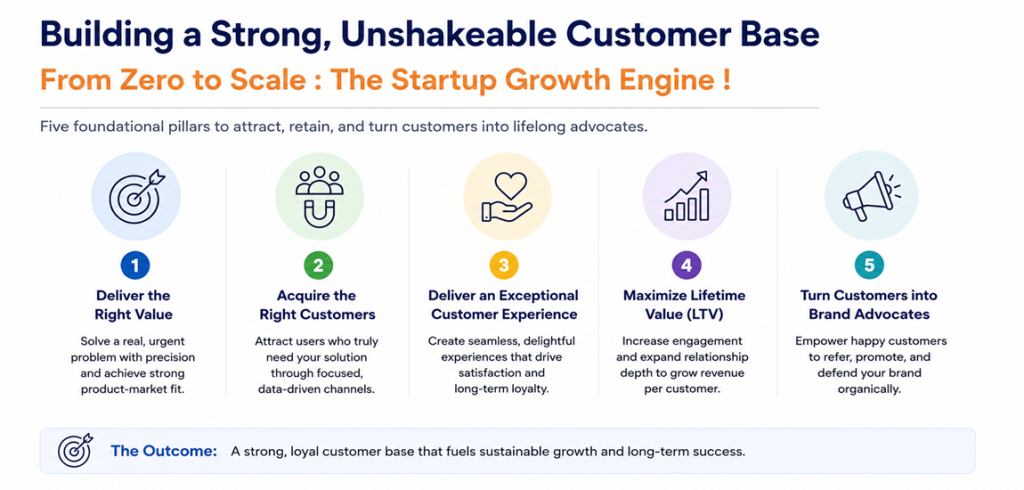
Securing a robust and loyal customer base for any early-stage firm is more than a milestone; it is the absolute foundation of long-term sustainability. Customer acquisition is only the tip of the iceberg in today’s dynamic business environment. The fundamental test of a sustainable startup is its ability to retain consumers, maximize their lifetime value (LTV), and convert them into vocal brand supporters.
While large venture capital investments can temporarily hide poor customer dynamics through costly acquisition campaigns, long-term success necessitates fundamental, customer-focused efficiency. This detailed blueprint breaks down the five fundamental foundations of establishing a steadfast client base. To bridge the gap between theory and practice, each strategic pillar is examined through a detailed, real-world case study of an industry leader who used these precise principles to disrupt their market.
1. Delivering the Right Value to Customers
Every unsuccessful startup is built around a product that no one wants. True value delivery does not entail creating a slick piece of technology or a trendy consumer packaged commodity and then looking for an audience. It is about discovering an acute, underserved pain point in a specific target market and addressing it with precise precision.
The baseline lifecycle for discovering and optimizing this value requires a rigorous sequence: you must begin with deep market research, use those insights to identify a highly specific unmet pain point, deploy a lean minimum viable product into the wild, and continuously iterate until you achieve definitive product-market fit.
Understanding Customer Needs Through Constant Discovery
Startups must approach market research not as a one-time launch checklist, but as a continuous loop.
- Continuous Qualitative Inquiries: While quantitative surveys offer scale, deep user interviews yield the emotional context behind a consumer’s choice. Startups should regularly interview active users, churned users, and non-buyers to map the emotional and functional friction points in their daily workflows.
- Active Competitor Deconstruction: True research involves studying where competitors frustrate their audiences. Scouring public forums, Reddit communities, and negative reviews of established players reveals the exact product gaps an agile startup can exploit.
- Inline Insight Capture: Modern product development integrates feedback loops directly into the user experience. By deploying contextual, low-friction micro-surveys at specific friction points—such as right after an onboarding flow or immediately following a checkout—startups capture real-time sentiment rather than relying on delayed, low-response email blasts.
Engineering and Validating Product-Market Fit (PMF)
Product-Market Fit is the inflection point where a product’s value proposition perfectly aligns with a highly urgent market demand. Achieving it requires rigorous methodology and operational discipline.
- The Minimum Viable Product (MVP) Framework: Startups must build the leanest possible iteration of their idea that still delivers core value. The goal of an MVP is not to generate massive revenue, but to maximize validated learning with the least amount of capital expended.
- Controlled Beta Deployments: Rolling out features to a restricted, highly engaged cohort of early adopters prevents broad-scale brand damage while exposing technical bugs and usability flaws. This core group acts as a sounding board, guiding the product toward stability.
- The Sean Ellis 40% Benchmark: To quantitatively measure PMF, startups should ask their users: “How would you feel if you could no longer use this product?” If 40% or more respond with “very disappointed,” the startup has achieved a baseline level of product indispensability and is ready to scale acquisition.
Case Study 1: Superhuman – Deconstructing PMF via Mathematical Optimization
When Rahul Vohra founded the premium email client Superhuman, he faced a classic startup dilemma: how do you know exactly when a product is ready to transition from stealth development to aggressive marketing expansion? Rather than relying on gut feeling, Vohra transformed the elusive concept of Product-Market Fit into a metric-driven optimization process.
The technique adhered to a tight optimization pipeline. It began with a Sean Ellis score that indicated that only 22% of users would be “very disappointed” without the product. The methodology then broke into two parallel tracks: segmenting the advocates to focus on speed and keyboard shortcuts, and evaluating the fence-sitters to create the exact features required to convert them. This systematic procedure ultimately increased their optimum score to a decisive 58%.
The Strategy
Superhuman began by polling its early users with the Sean Ellis framework. The initial findings were extremely concerning: only 22% of respondents stated that they would be “very disappointed” if the product disappeared.
To systematically move this number, Vohra identified the 22 percent of consumers who loved the product and evaluated their characteristics. He noticed that these key supporters were professionals whose daily productivity depended largely on email—such as venture investors, founders, and business development executives.
.
He then implemented a dual-track product optimization strategy:
- Polishing the Core Strengths: He focused half of his engineering resources on building features that his core advocates adored, specifically doubling down on absolute speed, keyboard-only shortcuts, and instant search capabilities.
- Addressing the Fence-Sitters: He used the remaining half of his resources to tackle the main objections of the users who answered that they would be somewhat disappointed if Superhuman disappeared. He deliberately ignored the feedback of users who wouldn’t care if the product vanished, as their needs did not align with the product’s true value proposition.
The Result
Superhuman’s main statistic progressively increased as it built features particularly designed to convert fence-sitters into advocates, such as mobile applications, advanced calendar integrations, and bespoke reminders. Within quarters, the percentage of users who would be “very disappointed” without the app increased from 22% to a whopping 58%, well above the industry standard for product-market fit.
This metric-driven strategy enabled Superhuman to charge a premium subscription fee of $30 per month for an application built on top of free, existing email protocols such as Gmail.
2. Planning for Exceptional Customer Experiences
In an age of hyper-commoditization, where software code can be reproduced and supply chains are widely available, User Experience (UX) and Customer Experience (CX) have emerged as the most important differentiators. An outstanding customer experience reduces the cognitive burden necessary to interact with a firm, transforming routine transactions into seamless trips.
To accomplish this, entrepreneurs must create a new, multilayered architecture for consumer interactions. The foundation is built on a unified omnichannel engine that enables full cross-platform context parity. Above that, there is a layer of predictive personalization that handles dynamic, contextual routing depending on user behavior. Finally, the system is completed with an intelligent hybrid support structure that combines an automated AI routing layer with tier-3 human specialists for high-value situations.
Implementing Deep Personalization and Structural Convenience
Personalization must extend beyond merely injecting a customer’s first name into an email subject line. True personalization adapts the entire environment to a user’s explicit behavior and past preferences.
- Behavior-Driven UI Layouts: Advanced startups use real-time analytics to dynamically modify user interfaces based on historical usage. For example, a business-to-business (B2B) SaaS dashboard should prioritize entirely different modules for a chief financial officer than it does for a front-end engineering lead.
- Frictionless Transaction Paths: Every click required to complete a purchase drastically lowers conversion rates. Startups must relentlessly streamline their checkout operations by adopting single-click checkout protocols, integrating modern digital wallets, and auto-filling repeat shipping data.
- Cross-Channel Context Retention: A customer transition across touchpoints should never reset their interaction history. Whether a user moves from an iOS app to a desktop experience, their active cart items, system preferences, and recent search profiles must sync with absolute parity.
Engineering Rapid, High-Responsiveness Support Architecture
When a customer encounters a technical error or order delay, the speed and quality of the response directly determine whether they remain loyal or defect to a competitor.
- Intelligent AI Deflection Layers: Implementing modern, retrieval-augmented generation (RAG) conversational agents allows a startup to immediately deflect up to 70% of routine informational queries—such as tracking updates or password resets—without manual human intervention.
- Dynamic Tier-Based Routing Engines: Inbound service issues should be instantly categorized by urgency and customer lifetime value. High-priority commercial bugs must bypass basic ticket queues entirely and land directly with senior resolution engineers.
- Asynchronous Messaging Integrations: Startups must go beyond traditional ticketing systems by embedding native support channels within popular consumer applications like WhatsApp and live chat. This enables users to resolve issues naturally on their own timelines without waiting on hold.
Case Study 2: Ritz-Carlton – The $2,000 Empowerment Rule
While the Ritz-Carlton operates within the hospitality industry rather than the technology sector, its hyper-engineered approach to customer experience serves as the foundational gold standard for modern customer retention across all industries.
Their operational sequence is simple but effective: as soon as a client issue is identified, a frontline staff is authorized to design and implement a remedy on the spot. They can use a discretionary limit of up to $2,000 per occurrence, resulting in an immediate resolution that eliminates management delays.
The Strategy
The foundation of Ritz-Carlton’s legendary experience strategy is a radical, corporate-wide policy: every single frontline employee—including housekeepers, front desk agents, and luggage handlers—is given explicit authority to spend up to $2,000 per guest, per incident, to resolve any customer issue or create an unforgettable positive experience, regardless of management approval.
This guideline eliminates any operational friction, which normally cripples standard corporate customer service setups. If a guest indicates that they forgot their laptop charger, a staff does not open a ticket or seek supervisor approval. They promptly buy a replacement charger and deliver it to the guest’s room.
The strategy relies on three core operational pillars:
- Absolute Frontline Autonomy: Eliminating multi-layered approval processes allows the brand to fix customer problems instantly, preventing minor frustrations from escalating into permanent customer churn.
- Systematic Narrative Capture: Every instance of employee empowerment is documented within a centralized global database, allowing properties worldwide to anticipate a returning guest’s preferences.
- Shifting from Deficit to Delight: Capital is deployed not just to fix operational errors, but to actively surprise guests during major life milestones, transforming a standard stay into an emotionally resonant event.
The Result
By viewing customer experience as a real-time operational capability rather of an administrative cost center, Ritz-Carlton obtained the top customer retention metrics in the premium accommodation industry. The $2,000 rule’s return on investment is realized through an industry-leading lifetime value per client and a consistent stream of organic, word-of-mouth marketing, which significantly decreases traditional customer acquisition expenditures.
3. Building Customer Loyalty
Acquiring a new customer is up to five times more expensive than retaining an existing one. Long-term profitability is unlocked when a business transitions a customer away from transactional evaluations and toward deep, institutional brand loyalty.
To understand this change, consider the striking difference between a transactional buyer and an emotional advocate. A transactional buyer analyzes options primarily on price, has extremely low switching barriers, and is especially vulnerable to competition advertising. In contrast, an emotional advocate really loves the brand’s community, confronts substantial systemic switching costs, and often overlooks minor operational flaws due to the deeper relationship.
Cultivating High-Engagement Brand Communities
A brand community shifts the relationship between the startup and the customer from a series of isolated sales into a shared identity.
- Shared Virtual Gathering Spaces: Establishing dedicated, moderated spaces via platforms like Discord or Slack allows core users to interact directly with one another, share best practices, and collaborate on advanced product use cases.
- Tiered Value-Driven Incentives: Traditional loyalty programs often fail because they offer generic, low-value rewards. High-impact programs reward high-value behaviors with non-monetary perks, such as early beta access to new features, direct design consultations with product teams, or invitation-only executive roundtables.
- User-Generated Content Amplification: Actively featuring and highlighting the work, insights, and achievements of your user base within company marketing channels builds a deep sense of mutual validation and ownership.
Maintaining Product Reliability and Structural Trust
Community alone cannot sustain a business if the core product fails to deliver consistent results. Trust is built when a company maintains absolute reliability.
- Radical Operational Transparency: When systemic outages or product recalls occur, startups must avoid defensive public relations language. Providing detailed, transparent post-mortems that explain exactly what went wrong and how it will be prevented builds deep trust.
- Clear Risk-Mitigation Commitments: Offering comprehensive warranties, explicit performance service level agreements (SLAs), and hassle-free return windows lowers the psychological barrier to purchasing from a young, unproven startup.
- Proactive Quality Assurance Controls: Implementing continuous automated testing pipelines and regular user interface reviews ensures that product updates never break existing workflows or degrade the core user experience.
Case Study 3: Harley-Davidson – The H.O.G. Community Engine
In the mid-1980s, Harley-Davidson was on the brink of complete financial collapse, facing intense competition from highly reliable, lower-cost Japanese manufacturers. The brand survived and built a dominant market position not by out-engineering its competitors, but by institutionalizing its customer base into a powerful subculture.
Their system transforms a one-time transaction into an ongoing relationship by following a specific progression: it begins with a transactional motorcycle sale, immediately enrolls the buyer in the Harley Owners Group (H.O.G.), progresses to participation in local chapter events and group rides, and eventually leads to a deep lifestyle integration characterized by branded apparel, community advocacy, and life-long customer loyalty.
The Strategy
Harley-Davidson launched the Harley Owners Group (H.O.G.), a brand-sponsored community structured to connect riders directly with corporate executives and with each other. This was not a standard marketing newsletter; it was a deeply organized, local-chapter community engine that turned a mechanical consumer purchase into a core personal identity.
The operational elements of this strategy included:
- Breaking Corporate Barriers: Executives and product designers regularly attended local H.O.G. rallies, riding alongside customers and gathering unfiltered qualitative feedback on the product experience.
- Monetizing the Ecosystem: The company created a massive ecosystem of high-margin accessories, branded apparel, and customized components, transforming a one-time motorcycle purchase into a multi-decade stream of recurring revenue.
- Creating High Switching Costs: When a competitor launched a cheaper or faster motorcycle, a H.O.G. member would rarely switch. Leaving Harley-Davidson meant leaving their entire social circle, their weekend activities, and their primary community.
The Result
The H.O.G. network grew to over one million active members globally, becoming the primary pillar of Harley-Davidson’s corporate turnaround. By focusing heavily on building an authentic community, the company achieved an extraordinary 90%+ customer retention rate. The brand’s relationship with its audience became so deep that customers regularly tattooed the corporate logo onto their bodies—the ultimate expression of unbreakable customer loyalty.
4. Attracting New Customers
While keeping existing customers happy is vital for retention, a company cannot scale without a predictable engine for acquiring new users. The goal for early-stage companies is to construct sustainable acquisition channels that keep customer acquisition costs (CAC) well below customer lifetime value (LTV).
An optimal startup acquisition engine functions as a balanced ecosystem rather than a single channel. On the one hand, inbound SEO and organic content work together to build long-term value. On the other hand, highly focused programmatic advertisements are used to increase short-term velocity. Both sides contribute to a centralized, viral word-of-mouth loop that leverages double-sided referral incentives to drive growth.
Deploying Modern Digital Marketing Engines
Startups must construct an acquisition funnel that balances long-term organic traffic with immediate, highly targeted paid traffic.
- Compounding SEO Architectures: Instead of chasing highly competitive, short-tail keywords, startups should construct programmatic content networks focused on highly specific, long-tail search queries that match explicit transactional intent.
- Strict Unit-Economic Paid Campaigns: Paid advertising on channels like Google or Meta must be managed with tight data controls. Campaigns should be tracked down to the exact cohort level, ensuring ad spend is directed only toward user groups that yield high retention rates.
- Structured High-Value Sampling: Providing low-barrier, ungated access to a product’s core value—through structured free trials, comprehensive freemium tiers, or physical product samples—allows prospective buyers to experience value before spending money.
Structuring Viral Word-of-Mouth Dynamics
The most efficient acquisition channel is an existing, highly satisfied customer who brings their peers into the product ecosystem.
- Double-Sided Value Incentives: Referral programs are highly effective when they reward both the existing advocate and the incoming lead with real value, such as bill credits or exclusive product features, rather than generic corporate branded gifts.
- In-Product Virality Triggers: Products should be engineered to naturally invite collaboration. For example, a document editor or project management tool should make it effortless for a user to invite an external partner, turning standard product usage into a direct driver of new customer acquisitions.
- User-Generated Content Frameworks: Providing customers with highly visual, easy-to-share summaries of their data or accomplishments—similar to Spotify’s annual “Wrapped” campaign—incentivizes users to organically promote the brand across their social networks.
Case Study 4: Dropbox – Engineering Exponential Growth via Two-Sided Virality
In its early days, Dropbox faced a massive challenge: traditional search engine marketing and paid ad campaigns were costing them between $288 and $388 to acquire a single customer. Given that their product was a $99 per year subscription, their unit economics were completely broken. To survive, they had to reinvent how they acquired customers.
Their solution was based on a quick loop: User A invites User B, User B installs the application, and both users immediately earn 500MB of free cloud storage space. This initiates an immediate reward cycle that loops back to the beginning as consumers search for more space.
The Strategy
Inspired by PayPal’s early financial referral programs, Dropbox implemented a native, double-sided referral system built directly into their product’s onboarding flow.
Instead of offering cash, which would create a heavy cash-flow drain on an early-stage startup, Dropbox used its own core infrastructure as currency. If an existing user invited a friend who successfully installed the application, both individuals immediately received 500 megabytes of bonus cloud storage space completely free of charge.
The system succeeded because it removed structural friction:
- Instant, Contextual Rewards: The incentive was deeply tied to the product experience. A user running out of storage space could solve their problem immediately by inviting a colleague.
- Absolute Onboarding Simplicity: The referral mechanism was built directly into the account creation wizard, allowing users to sync their personal contact lists and send invitations with a single click.
- Double-Sided Validation: Rewarding both parties removed the social awkwardness of inviting a friend, reframing the invitation from a commercial ad into a helpful, value-sharing gesture.
The Result
The results of this referral loop were immediate and dramatic. Dropbox’s signups increased by a staggering 3900% in a 15-month window.
The company grew from 100,000 registered users to over 4,000,000 users without spending a single dollar on traditional advertising campaigns. This engineered viral loop lowered their customer acquisition cost close to zero, transforming Dropbox into one of the fastest tech startups to reach a multi-billion-dollar valuation.
5. Nurturing Customer Relationships
The journey does not end when a transaction is completed or a referral is made. To create a highly predictable, sustainable business model, businesses must actively maintain and nurture their client relationships over lengthy periods of time in order to maximise customer lifetime value (LTV) and prevent customer churn.
To manage this methodically, companies must establish a rigorous feedback-to-retention pipeline. The first step necessitates ongoing feedback collection using measures such as NPS, CSAT, and direct product usage tracking. This information feeds into the second phase, which is an automated diagnostic analysis aimed at identifying high-churn groups. The final phase initiates a proactive success intervention, utilizing targeted value optimization to save the connection before an account is cancelled.
Developing Strategic, Value-Driven Communication Funnels
Every touchpoint with a customer after a sale must deliver clear value. Repetitive, purely promotional outreach quickly leads to unsubscriptions and brand fatigue.
- Educational Lifecycle Campaigns: Email communication should focus on driving deep product adoption. Startups must build automated onboarding sequences that teach users how to unlock advanced, high-value product features based on their specific usage history.
- Data-Driven Triggered Interventions: Automated systems should monitor user activity to detect drops in engagement. If a B2B user’s activity falls by 50% over a one-week period, it should automatically trigger a personalized check-in from a customer success manager to resolve any underlying issues before the user churns.
- High-Value Industry Content: Publishing authoritative, deeply researched white papers, actionable industry templates, and detailed market trend analyses positions your startup as a trusted advisor rather than just another software or product vendor.
Designing Active Voice-of-Customer Loops
A company’s customer feedback system must serve as a core driver of the product development roadmap, not just an administrative metric for support teams.
- Systematic Metric Tracking: Startups should run a continuous Net Promoter Score (NPS) and Customer Satisfaction (CSAT) measurement program to identify happy advocates and uncover hidden product frustrations.
- Closing the Loop with Users: When a customer takes the time to submit a feature request or report a bug, the company should update them directly once that issue is resolved. This level of responsiveness shows customers that their feedback directly impacts the business.
- Proactive Churn Analysis: Every single cancellation or customer defection must undergo a formal root-cause analysis. Uncovering systemic patterns in why users leave allows a startup to optimize its product and messaging to protect its remaining customer base.
Case Study 5: Salesforce – Inventing the Customer Success Discipline
In 2005, Salesforce was growing its new customer count rapidly, but it faced a hidden, existential threat: the company was experiencing an annual customer churn rate of nearly 8% per month. This meant that nearly all of its hard-earned customers were leaving the platform every single year, completely wiping out the revenue gains from their sales teams.
The business change necessitated a major structural shift. The former strategy relied solely on traditional reactive assistance, resulting in an 8% monthly attrition rate. To survive, they established a dedicated “Customers for Life” campaign, which introduced proactive adoption tracking, drastically altering user engagement and revealing highly scalable, negative attrition dynamics.
The Strategy
Marc Benioff realized that in a subscription-based business model, closing a sale is just the beginning. If customers do not actively adopt and derive value from software, they will cancel their subscription as soon as the contract ends. To fix this, Salesforce created an entirely new corporate function: Customer Success, launching a dedicated team called “Customers For Life.”
The core components of this relationship strategy included:
- Shifting from Reactive to Proactive Support: Traditional customer support waits for a user to call with an issue. The Customer Success team proactively monitored real-time user adoption data to flag organizations that weren’t actively using their purchased software licenses.
- Focusing on Business Outcomes: Success managers stopped talking about software features and began focusing on the customer’s key business metrics, training sales teams on how to use Salesforce to directly increase their close rates.
- Executive Alignment: Customer Success metrics were elevated directly to the executive leadership team, making user retention just as critical a corporate milestone as new sales bookings.
The Result
By building an organization focused entirely on nurturing customer relationships and driving product adoption, Salesforce successfully brought its catastrophic churn metrics down to near-zero levels. This strategy unlocked an enterprise SaaS phenomenon known as Net Negative Churn, where revenue expansions from existing customers far outpaced the losses from cancellations. This powerful financial engine propelled Salesforce to global enterprise software dominance.
6. Comprehensive Blueprint: Glossier’s Customer-Centric Masterclass
To understand how these five strategic pillars fit together into a single, cohesive growth strategy, we can look at the rise of the beauty startup Glossier. Founded by Emily Weiss in 2014, Glossier transformed from a simple beauty blog into a billion-dollar direct-to-consumer (DTC) empire by turning traditional cosmetics marketing completely on its head.
The beauty empire’s growth loop worked as a self-sustaining system. It began with the Into The Gloss blog, which aims to drive deep market discovery. These findings were directly applied to co-created products, resulting in unquestionable product-market fit. Once launched, these items occupied a community Slack channel and generated double-sided incentives, resulting in organic, viral customer acquisition. This user base was then maintained through a frictionless CX and support layer, resulting in high retention and lasting brand advocacy.
Pillar 1: Delivering True Value Through Content-Driven Discovery
Long before Glossier sold a single product, Emily Weiss ran a beauty blog called Into The Gloss. By conducting interviews with thousands of women regarding their daily skincare routines, she gathered years of unfiltered consumer market research.
She uncovered a large, neglected pain point: traditional cosmetic companies were alienating modern consumers by pushing heavy, full-coverage products with unrealistic expectations of perfection. The market sought minimalist, breathable skincare-cosmetic hybrids that prioritized “skin first, makeup second.” Glossier’s first four products were developed in response to explicit, crowdsourced consumer demand.
Pillar 2: Planning Exceptional Customer Experiences
Glossier designed an online shopping experience built around personalization and authentic, peer-led discovery. Their digital storefront used highly diverse, unretouched real-world imagery, making the purchasing process feel approachable and transparent.
To bridge the gap between digital retail and physical retail, their customer support agents—affectionately named the “gTeam”—were trained to operate not as transactional ticket handlers, but as personal beauty consultants. They engaged in long, natural text-message conversations with buyers, offering customized skincare routines and shade-matching advice based on user photos.
Pillar 3: Building a Deep Brand Community
Glossier transformed their audience into engaged stakeholders. They invited their top 100 most active customers to a secret Slack channel, granting them direct access to product development teams.
When designing a new face cleanser, the company asked the community exactly what they wanted in a face wash. The resulting product, Milky Jelly Cleanser, was developed in direct collaboration with the target demographic. Glossier differentiated itself from traditional cosmetics competitors by offering clients a genuine voice in the creation process.
Pillar 4: Attracting New Customers Through Organic Advocacy
Customers shared their purchases online because the products were made with very beautiful, simple packaging that was perfectly suited for Instagram. Glossier transformed user-generated content into an effective customer acquisition tool.
They launched a very rewarding referral scheme that enabled ordinary people to behave as micro-influencers, earning product discounts and commissions for sharing their personalized purchasing URLs. This technique turned word-of-mouth recommendations into their major engine for business growth, allowing them to keep customer acquisition expenses significantly lower than traditional beauty giants.
Pillar 5: Nurturing Long-Term Customer Relationships
Glossier maintains an open, continuous feedback loop with its customer base. Every comment on Instagram, review on their website, and email to support is systematically tracked and delivered directly to their product formulation teams.
When an early batch of a product received feedback that the scent was slightly overpowering, the company openly acknowledged the input, quickly re-engineered the formula, and proactively shipped updated versions to initial buyers. This absolute commitment to acting on customer feedback transformed casual buyers into lifelong brand advocates.
Strategic Blueprint Matrix
To help implement these concepts systematically, here is an operational breakdown of how each growth pillar, core validation metric, execution strategy, and real-world case study link together:
- Value Delivery Growth Pillar
- Core Metric to Track: Sean Ellis Score (Targeting greater than 40%)
- Execution Strategy: Run lean MVP trials; iterate features based strictly on fence-sitter feedback.
- Proven Case Study: Superhuman
- Customer Experience Growth Pillar
- Core Metric to Track: Customer Effort Score (CES)
- Execution Strategy: Empower frontline teams with autonomy; maintain context across all communication channels.
- Proven Case Study: Ritz-Carlton
- Brand Loyalty Growth Pillar
- Core Metric to Track: Net Promoter Score (NPS)
- Execution Strategy: Build dedicated community spaces; prioritize user-led co-creation.
- Proven Case Study: Harley-Davidson
- Customer Acquisition Growth Pillar
- Core Metric to Track: LTV to CAC Ratio (Targeting greater than 3:1)
- Execution Strategy: Engineer double-sided, product-integrated referral loops to scale virally.
- Proven Case Study: Dropbox
- Relationship Nurturing Growth Pillar
- Core Metric to Track: Net Revenue Retention (NRR)
- Execution Strategy: Shift from reactive support to proactive customer success; track real-time product adoption data.
- Proven Case Study: Salesforce
Actionable Next Steps
Building an unshakeable customer base is not a project with a fixed end date—it is an ongoing operational commitment. For an early-stage startup, scaling acquisition before securing product-market fit and building a reliable retention engine is the equivalent of pouring water into a leaky bucket.
To transition your business onto a sustainable, high-retention growth path, audit your current customer operations against these five foundational questions:
- Value: Have you surveyed your current user base to see if at least 40% would be completely lost without your product?
- Experience: Are you forcing your support teams to follow rigid, multi-layered approval scripts, or are they empowered to resolve customer issues instantly?
- Loyalty: Does your brand offer a shared identity and community, or are your transactions evaluated purely on price?
- Acquisition: Is your product engineered to naturally encourage viral referrals, or are you dependent entirely on expensive paid advertising?
- Nurturing: Are you tracking real-time user adoption data to proactively save accounts before they cancel, or are you waiting until they file a churn request?
By methodically examining these pillars and incorporating customer-centric discipline into your everyday product building, your firm may create an unbreakable customer engine capable of enduring market turbulence and scaling efficiently in the long run.



More Blogs
Balancing Short-Term Goals with Long-Term Vision !
Adapting to Change: A Challenge for Startups
Accessing New Markets: A Challenge for Startups