


Pic - AI Generated
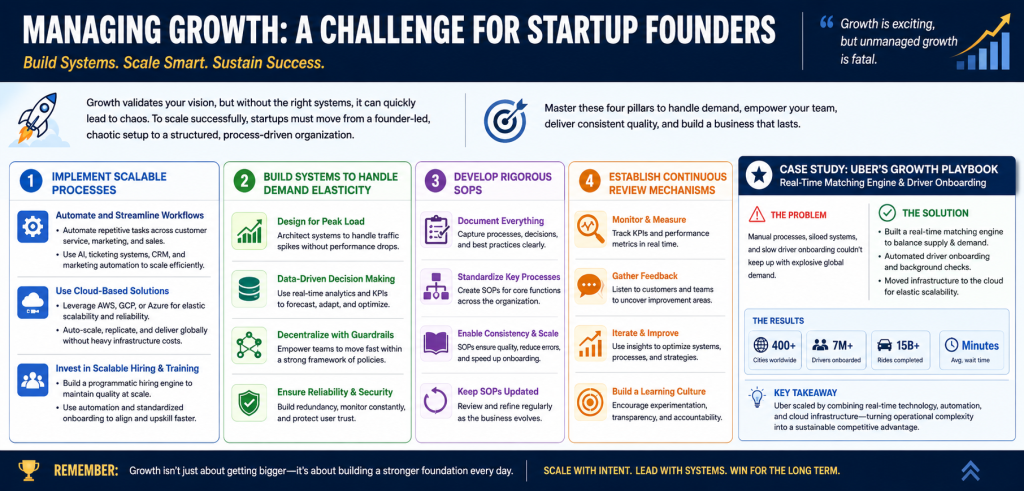
Growth is one of a startup’s most unstable stages, but it is also the ultimate confirmation of its vision. Rapid growth often turns a dream into an operational nightmare for many founders. Underlying fissures in infrastructure, culture, and procedures deepen into chasms as demand increases dramatically. Increasing demand, growing teams, and operational complexity all directly contribute to organizational turmoil, lowered product quality, and ultimately business failure in the absence of intentional expansion initiatives.
A startup must change from a disorganized, founder-led team of generalists to a highly structured, process-driven organization that can handle volume without a corresponding rise in overhead if it is to scale successfully. The implementation of scalable processes, the development of strict Standard Operating Procedures (SOPs), the establishment of continuous review mechanisms, and the construction of technological and operational systems to handle demand elasticity are the four fundamental pillars of managed expansion that are examined in this in-depth guide.
To ground these frameworks in real-world dynamics, we analyze how historic and contemporary market leaders navigated these exact inflection points :
1. Implement Scalable Processes
Scalability is the ability of a startup’s operations, technical infrastructure, and business model to readily handle a significant growth in volume or income without experiencing a linear, proportionate rise in operating expenses or administrative burden. In a non-scalable company, doubling your clientele necessitates double your workforce, which eliminates profit margins. Through structural efficiency, processes in a scalable firm adapt to meet demand.
A. Automate and Streamline Workflows
Manual labor is the enemy of velocity. Every repetitive task handled by a human represents an operational bottleneck and an unnecessary line item on the balance sheet. True scaling requires systematically identifying manual steps within your core funnels and transferring them to software.
- Customer Service Optimization: When user metrics jump 10x, standard email inboxes collapse. Scalable customer management requires implementing tier-structured ticketing platforms backed by natural language processing AI engines. Routine inquiries—such as password resets, order tracking, and basic troubleshooting—must be intercepted and resolved by automated systems, leaving high-value, complex anomalies to human tier-three support agents.
- Marketing Engine Automation: Early-stage marketing is highly bespoke and reactive. At scale, customer acquisition and retention must operate like an assembly line. This involves deploying automated drip campaigns tied to exact user behavior triggers, algorithmic programmatic ad bidding, and dynamic social media scheduling pipelines that keep users engaged throughout their lifecycle without requiring daily human intervention.
- Sales Architecture Integration: Enterprise and mid-market sales tracking cannot rely on memory or spreadsheets. Startups must deploy highly integrated Customer Relationship Management (CRM) tools customized with validation rules, automatic lead-scoring algorithms, and instant contract generation tools. This reduces administrative friction for account executives, maximizing their time spent closing deals.
B. Use Cloud-Based Solutions
The days of buying and setting up actual server racks in a nearby data center are long gone. Infrastructure needs to be considered software for a contemporary startup. Startups can access elastic, practically limitless computing environments by relying on top cloud infrastructure providers like Amazon Web Services (AWS), Google Cloud Platform (GCP), or Microsoft Azure.
Instead of requiring vertical scaling (increasing a single server’s raw power, which creates single points of failure), cloud-native designs enable platforms to easily handle sudden increases in demand through horizontal auto-scaling (adding new server instances dynamically). Additionally, these platforms provide global Content Delivery Networks (CDNs), serverless computing modules, and native managed database replication, enabling a lean technical team to support millions of concurrent transactions worldwide without being constrained by physical footprints.
C. Invest in Scalable Hiring and Training
Talent density is a frequent victim of hyper-growth. Hiring managers often sacrifice technical proficiency and cultural fit in order to fill positions when a business has to quadruple its workforce in six months. This results in organizational debt, which has the potential to bring down a business years later.
To avoid this, startups must build a programmatic hiring engine:
[Candidate Sourcing]
│
▼
[Automated Technical/Cognitive Screening]
│
▼
[Structured, Rubric-Based Panel Interviews]
│
▼
[Algorithmic Continuous Onboarding Program]
By utilizing automated screening assessments, standardized rubric-based panel interviews, and an algorithmic onboarding program (such as video-guided knowledge repositories and sandbox assignments), a company can guarantee that the 500th employee meets the exact same performance standards as the 5th employee.
Case Study: Uber’s Real-Time Matching Engine and Driver Onboarding
Uber faced an extraordinary operational issue during its early hyper-growth phase between 2011 and 2015: how to develop its ride-sharing marketplace globally across hundreds of cities at once. Tens of thousands of independent drivers had to be onboarded every week while juggling a complex, real-time supply-and-demand balance in each new market.
The Problem
Initially, Uber’s operations relied heavily on localized, manual processes. City teams were spinning up localized databases, running driver background checks through disparate regional agencies, and manually text-messaging drivers to coordinate shift availability. As ride volume exploded, this decentralized approach caused massive system outages, fragmented data architectures, and severe lag in driver onboarding, which left thousands of potential drivers stuck in administrative queues while waiting customers experienced surge pricing and long wait times.
The Scalable Strategy
To survive its own growth, Uber completely re-engineered its platform around automated, centralized, and cloud-elastic workflows:
- Architecting “DISCO”: Uber built a centralized dispatch and matching engine called DISCO (Dispatch Optimization). Utilizing cloud infrastructure, DISCO ingested trillions of real-time GPS data points from both riders and drivers every second. Instead of relying on manual oversight, the system used geospatial indexing algorithms to automatically match riders with the optimal driver based on predicted time of arrival, traffic patterns, and supply density.
- Automated Document and Screen Processing: Uber integrated automated background screening and machine-learning-driven document verification into its driver app. Instead of a local operations manager physically reviewing driver’s licenses, vehicle registrations, and insurance policies, optical character recognition (OCR) software scanned, verified, and cross-referenced these documents against government databases within minutes.
- Programmatic Driver Lifecycle: Marketing and driver engagement were shifted entirely to automated systems. If a driver downloaded the app but failed to complete their first trip within 48 hours, behavior-triggered CRM engines pushed out targeted SMS, in-app micro-training modules, and local fuel-incentive promos, guiding the driver to activation without a single human employee intervening.
The Outcome
By replacing regional manual operations with centralized cloud automation and machine learning engines, Uber managed to scale from handling a few million rides in 2012 to over one billion completed trips by 2015. The cost of onboarding an additional driver dropped significantly, enabling the startup to enter new international markets and maintain a dominant market position without expanding its local corporate headcounts at a linear rate.
2. Make Systems to Handle Increased Demand
Operational performance drastically declines when user acquisition exceeds system capacity. Long support lines, delayed shipment, and outages drive away early adopters and permanently damage a brand’s reputation in the marketplace. You must consciously include elasticity into your supply chain, IT stack, and customer service department in order to keep demand from ruining your company.
A. Optimize Supply Chain and Inventory Management
Growth puts a great deal of strain on physical logistics for e-commerce and physical goods firms. Using simple spreadsheets to manage inventory invariably results in either overpurchasing (trapping valuable capital in unsold inventory) or stockouts (losing income).
Early adoption of enterprise-grade Inventory Management Systems (IMS) and Enterprise Resource Planning (ERP) like NetSuite or SAP is necessary for scaling firms. From suppliers of raw materials to third-party logistics (3PL) warehouses, these technologies provide you with real-time visibility throughout the whole supply chain. Startups can use Just-In-Time (JIT) inventory tactics by using predictive demand-forecasting algorithms that take seasonal trends, past sales curves, and marketing pipeline estimates into account. This maintains fulfillment rates above 99% while optimizing warehouse footprint expenses.
B. Strengthen IT and Technical Infrastructure
For software-as-a-service (SaaS), consumer apps, and fintech startups, a sudden spike in traffic can saturate database connections, max out server CPU utilization, and crash the entire application stack. Building infrastructure to handle demand requires specific technical choices:
- Microservices Architecture: Moving away from a monolithic codebase (where the entire app runs as a single, massive program) toward microservices. In a microservices setup, distinct functions—such as user authentication, payment processing, and search engines—run independently. If payment traffic spikes, only the payment service needs to scale up, preventing a bottleneck from bringing down the entire app.
- Advanced Load Balancing: Deploying sophisticated load balancers to distribute incoming web traffic evenly across hundreds of redundant cloud server instances, ensuring no single server becomes overwhelmed.
- Database Caching and Sharding: Implementing in-memory caching solutions (like Redis) to instantly serve frequently accessed data without hitting the primary database. As data grows, implementing database sharding—breaking a single massive database down into smaller, faster, easily manageable pieces across multiple cloud servers—prevents query timeouts.
C. Build a Strong Customer Support System
Customer support tickets increase in tandem with transaction volume. A startup’s turnover rates increase if it only uses regular email threads, which obscures important customer issues.
Startups need to use contemporary help desk platforms like Zendesk or Freshdesk in order to handle large volumes. Every incoming query is handled by these platforms as a digital ticket that can be tracked and prioritized. In order to automatically forward high-priority issues (such billing failures or account lockouts) to senior agents immediately, startups must set up stringent Service Level Agreements (SLAs) within these technologies.
Concurrently, the help desk must feed data into an internal Knowledge Base, turning resolved tickets into public-facing FAQ articles. This enables self-service support, which deflects a large portion of incoming tickets before they ever reach an agent’s queue.
Case Study: Stripe’s Infrastructure Resilience During Black Friday / Cyber Monday
Stripe, the online payment processing giant, provides a clear example of scaling technical systems to meet massive, unpredictable demand spikes. As a financial infrastructure platform, Stripe cannot afford down-time; if Stripe drops offline for even a few consecutive minutes, millions of global businesses instantly lose the ability to accept payments.
The Problem
Stripe’s transaction volume started to rise quickly throughout its early growth years. The annual Black Friday and Cyber Monday (BFCM) shopping holidays were the true test. E-commerce traffic does not increase linearly during these times; instead, it surges by orders of magnitude in a matter of milliseconds when large retailers start worldwide promotional activities. In order to prevent massive cascading failures throughout their merchant network, Stripe’s core engineering team recognized that their legacy database clustering approaches and API architectures were vulnerable to connection starvation under severe transaction concurrency.
The Scalable Strategy
Stripe didn’t just buy more servers; they re-architected their entire transaction handling infrastructure for high availability and fault isolation:
[Incoming Merchant API Traffic Spike]
▼
[Rate Limiter (Token Bucket)] ──(Exceeded)──> [Graceful Drop / Retry Request]
(Within Threshold)
▼
[Idempotency Engine (Redis)] ──(Duplicate)──> [Return Cached Response]
(New Request)
▼
[Microservices / Sharded DB]
- Idempotency API Layer: Stripe engineered a robust, Redis-backed idempotency framework across all API endpoints. If a merchant’s system experienced network lag and accidentally sent the same payment transaction multiple times within a split second, Stripe’s system recognized the unique request key and returned the cached result of the initial attempt. This prevented duplicate charges for consumers and shielded internal databases from processing duplicate workloads.
- Aggressive Rate Limiting: To protect core financial Ledgers from being taken down by traffic surges or malicious DDoS attacks, Stripe implemented advanced token-bucket rate limiters at the edge of their network. If an unmanaged traffic spike threatened system stability, the rate limiters gracefully dropped non-essential requests while prioritizing active financial transactions.
- Isolated Database Sharding and Horizontal Elasticity: Stripe migrated its monolithic storage structures into highly distributed, sharded document databases. They isolated high-volume merchants into dedicated processing containers running on top of elastic AWS environments. This ensured that if a single mega-retailer experienced an unprecedented surge in buyers, the traffic was entirely contained within that specific infrastructure slice without impacting other merchants on the network.
The Outcome
Stripe successfully scaled its operations to process hundreds of billions of dollars in volume annually. During peak holiday seasons, its systems maintain “four nines” (99.99%) availability, handling tens of thousands of continuous requests per second. By focusing deeply on technical isolation, caching, and rate management, Stripe proved that a startup can support rapid global demand without compromising on security or stability.
3. Make Standard Operating Procedures (SOPs)
Ad hoc execution drives operations in the early phases of a startup. Founders and early hires are multifaceted individuals who exchange context through casual conversations. However, this implicit knowledge model completely collapses as the headcount increases from 10 to 100. Without clear documentation, various workers carry out the same duties in entirely different ways, which leads to varying product quality, varied customer experiences, and lengthy training cycles for new hires.
To fix this, a company must implement explicit Standard Operating Procedures (SOPs).
A. What are SOPs?
Standard Operating Procedures (SOPs) are formal, highly detailed, step-by-step written instructions that define exactly how an employee must execute a specific operational task within the organization. They are the codified operational playbook of the company.
SOPs are designed to remove ambiguity entirely; they shift a startup away from relying on individual heroics and move it toward systematic execution. With effective SOPs in place, any qualified employee can step into a functional role and execute a workflow with the exact same efficiency and precision as the person who originally designed the process.
B. Steps to Develop SOPs
Developing institutional SOPs is not a one-time administrative exercise; it is an ongoing operational commitment.
1. Identify Core Vulnerable Processes
▼
2. Document Processes with Clear Nuance
▼
3. Train & Enforce via Systematic Onboarding
▼
4. Audit, Review, & Update Continuously
Step 1: Identify Core Vulnerable Processes
Begin by mapping out the critical business functions that have the highest frequency of repetition or carry the highest risk of error if mismanaged. Focus heavily on customer-facing and financial operations: customer service onboarding, security patch deployment protocols, corporate spending approvals, and sales discovery pipelines.
Step 2: Document Processes with Clear Nuance
SOPs must be written with absolute clarity, avoiding vague generalities. Instead of writing, “Log into the system and handle the customer issue appropriately,” an effective SOP must read, “Navigate to the admin dashboard, enter the user’s account ID, check the billing history log, and if a double charge is visible, click ‘Issue Refund’ via the Stripe gateway drop-down menu.” Use step-by-step numbered lists, clear flowcharts, and screenshots to make the document easily scannable and unambiguous.
Step 3: Train and Enforce Systematically
A document hidden away in a company wiki is useless. SOPs must be integrated directly into your team training programs and daily tools. Link your operational checklists to project management workflows (like Asana, Jira, or Notion). When an employee opens an assignment, the exact SOP checklist must automatically load alongside the task description.
Step 4: Audit and Update Continuously
An outdated SOP is more dangerous than no documentation at all because it guides employees toward obsolete practices. Startups must build an auditing schedule where process owners review and update their respective SOP libraries every quarter. This ensures the documentation evolves alongside your software stack and business model.
C. Benefits of SOPs
- Total Quality Consistency: SOPs ensure that your product delivery, customer interactions, and engineering outputs remain uniform, safeguarding your brand equity during rapid growth.
- Drastic Reduction in Onboarding Friction: New hires can reference the SOP library to answer their own operational questions, cutting down training times by up to 60% and freeing up managers’ schedules.
- Clear Operational Accountability: When steps are clearly documented, there is no room for excuses like “I didn’t know that’s how it worked.” Responsibility is clear across every level of the company.
Case Study: McDonald’s Speedee Service System
While modern tech startups often look to software companies for scaling inspiration, the ultimate historical masterclass in building Standard Operating Procedures belongs to Richard and Maurice McDonald, and later Ray Kroc, through the creation of the Speedee Service System in 1948.
The Problem
In the 1940s, traditional American drive-in restaurants were highly inefficient. They featured large, chaotic menus that required highly skilled short-order cooks to prepare dozens of different items on demand. Customer wait times frequently exceeded 30 minutes, order accuracy was low, and broken dishes and high staff turnover continually ate into profit margins. The entire business model depended heavily on individual cooks working in chaotic environments.
The Scalable Strategy
The McDonald brothers shut down their successful drive-in restaurant for several months to entirely re-imagine their operation as a high-velocity manufacturing plant. They map out their new process through clear, repeatable steps:
- Menu Rationalization: They slashed their menu from 25 items down to just 3 core selections: the hamburger, cheeseburger, and fries. This allowed them to standardize every single step of production.
- The Tennis Court Blueprint: The brothers drew full-scale layouts of their kitchen design in chalk on a local tennis court. They had their staff walk through mock hamburger assembly steps on this layout for days. By monitoring movement patterns, they redesigned the physical kitchen layout to minimize footsteps, optimize ergonomics, and completely eliminate physical bottlenecks.
- Codified Production Checklists: Every single task was broken down into precise, unchangeable SOPs. The exact temperature of the grill was locked in; the amount of condiments applied to a burger was standardized down to a fraction of an ounce using custom condiment dispensers; and the exact seconds a basket of fries spent in the oil oil was strictly timed.
[Raw Patty Placed on Precision-Heated Grill]
(Exactly Timed Grilling)
▼
[Patty Placed on Bun via Specialized Assembly Line]
(Mechanical Dispenser: Exact Condiment Ratios)
▼
[Wrapped in Protective Paper & Placed in Warming Bin]
(Ready for Cashier)
The Outcome
This rigorous standard operating system allowed McDonald’s to produce a hot, uniform hamburger in just 30 seconds, down from 30 minutes. When Ray Kroc discovered this system, he realized that the absolute predictability of the SOPs made the entire business model infinitely replicable. By licensing this codified operating blueprint globally, McDonald’s scaled into one of the largest food service enterprises in human history, proving that operational standardization is the engine of global scale.
4. Establish Strong Review Mechanisms
Scaling a startup without robust review mechanisms is like accelerating a high-performance vehicle into a thick fog: you are moving fast, but you have no visibility into oncoming hazards. When a company is expanding rapidly, underlying systemic issues—such as rising customer acquisition costs, deteriorating user retention, or falling employee morale—can easily be masked by surging top-line revenue growth. To build a sustainable business, founders must implement formal, continuous feedback loops and metric tracking across every layer of the organization.
A. Performance Metrics & KPIs (Key Performance Indicators)
You cannot manage what you do not measure. A growing startup must shift away from tracking surface-level vanity metrics (such as total registered users or press release views) and focus on hard, unit-economic realities.
B. Regular Team Meetings and Feedback Loops
Data metrics only tell you what is happening; structured team meetings and communication frameworks explain why it is happening.
Startups must move away from unstructured status updates and implement high-efficiency meeting frameworks, such as the OKR (Objectives and Key Results) methodology coupled with Agile Standups. Every single department should participate in a weekly review session where actual performance is directly evaluated against target key results.
Crucially, founders must build a safe workplace culture that encourages transparent, two-way feedback loops. Frontline customer success representatives and junior software engineers often spot operational bottlenecks weeks before they impact executive dashboards. Providing structured paths for bottom-up communication—via anonymous pulse surveys or bi-weekly retrospectives—ensures that internal problems are voiced and addressed before they turn into major crises.
C. Customer Feedback and Market Analysis
As organizations scale, founders naturally become more removed from the daily reality of their customer base. This isolation can lead to product drift, where the company builds features that do not align with evolving market demands.
To combat this distance, startups must automate user feedback collection at scale:
- Net Promoter Score (NPS) Loops: Programmatically triggering NPS surveys at critical points in the user journey (e.g., right after a successful purchase or product deployment) to gauge real-time customer satisfaction.
- Systematic Customer Interviews: Product managers must maintain a regular schedule of live user feedback interviews to look past numerical analytics and uncover real customer motivations.
- Continuous Competitor Benchmarking: Dedicating team resources to constantly analyze competitor feature releases, pricing adjustments, and market shifts, ensuring the startup maintains a strong value proposition.
Case Study: Intel’s Deployment of OKRs (Objectives and Key Results)
During the late 1970s and 1980s, tech giant Intel was navigating an intense competitive landscape. Led by legendary executive Andy Grove, the company had to pivot its core business from memory chips to microprocessors while managing a massive explosion in global headcount. To keep the expanding organization aligned, Grove invented and deployed the OKR (Objectives and Key Results) management framework.
The Problem
As Intel added thousands of engineers, marketers, and operations specialists globally, internal communication began to splinter. Different engineering departments were building product architectures that didn’t align with what the sales teams were promising clients. The executive team lacked an efficient, uniform mechanism to monitor alignment across multiple continents, leading to missed ship dates and costly project overlaps.
The Scalable Strategy
Andy Grove introduced OKRs as an open, accessible review system designed to drive complete organizational alignment from senior executives down to entry-level assembly engineers.
[CEO’s Strategic OKRs]
(Cascades Downward)
▼
[Departmental Lead OKRs]
(Cascades Downward)
▼
[Individual Engineer OKRs]
The system operated on a few strict, unyielding principles:
- Absolute Focus: An individual or department could have no more than 3 to 5 clear Objectives per quarter.
- Hard Quantification: Objectives had to be aspirational, but the accompanying Key Results had to be completely objective and measurable. As Grove famously stated: “If it does not have a number, it is not a Key Result.”
- Complete Transparency: Every person’s OKRs—including Andy Grove’s own CEO objectives—were published openly across the internal network. Any engineer could look up exactly what goals their colleagues or managers were working toward, completely eliminating organizational silos.
The Outcome
The OKR framework gave Intel an incredibly agile and resilient corporate structure. When Motorola launched a superior microprocessor that threatened to capture the market, Intel used its OKR system to pivot the entire global workforce within weeks. Every department aligned their key goals toward a single corporate mission: “Operation Crush.”
Intel successfully out-competed Motorola to establish its x86 architecture as the dominant computing standard. The OKR system proved so effective at managing hyper-growth that venture capitalist John Doerr later introduced it to the founders of Google, where it remains the foundational management engine today.
Deep-Dive Business Case Study: How Airbnb Navigated Hyper-Growth
Founded in 2008 by Brian Chesky, Joe Gebbia, and Nathan Blecharczyk, Airbnb grew from a scrappy, desperate air-mattress-rental concept into a global platform that disrupted the hospitality industry. However, its path from a small Y-Combinator startup to a public market leader provides an excellent case study on the operational friction, system collapses, and strategic pivots that define the hyper-growth journey.
[2008: Scrappy Roots]
Air mattresses on floors; manual founder photography in NYC.
▼
[2011-2014: Hyper-Growth Influx]
Global booking explosion; severe legal, customer service, and trust cracks emerge.
▼
[The Critical Strategic Pivot]
• Process Scale: Automated trust tooling & ID verification.
• System Scalability: Moved to a containerized microservices cloud stack.
• Codified SOPs: Built “Hospitality Standards” & global host manuals.
• Review Engines: Deployed real-time data metrics & mandatory customer review loops
▼
[Sustainable Market Leadership]
A robust, highly profitable, and universally trusted global platform ecosystem.
1. The Scaling Crisis: The Nightmares of Sudden Expansion
Between 2011 and 2014, Airbnb experienced a massive explosion in booking volume. As venture capital poured in and global user counts surged, the company’s informal, founder-led processes began to fracture under the pressure of international demand:
- The Trust and Safety Breakdown: In 2011, an early host’s home was completely vandalized by a guest. Because the startup lacked a formal customer support setup or security review protocols, the host’s urgent requests were buried in unmanaged email inboxes for days. The incident turned into a public relations crisis, threatening the core assumption of the platform: that strangers could trust one another.
- The Local Legal Mosaic: As Airbnb expanded into thousands of international cities, it ran directly into a complex web of local municipal housing laws, tax regulations, and hotel zoning codes. The corporate office could not manually track compliance across every unique jurisdiction.
- Customer Support Overwhelm: With millions of bookings occurring across multiple time zones, standard call queues backed up. Language barriers, payment errors, and last-minute cancellation crises threatened to ruin guest holidays, resulting in high customer churn and a drop in brand reputation.
2. Implementing Scalable Processes via Technical Automation
Recognizing that manual oversight could no longer sustain their growth, the founders turned to advanced technology to automate their core trust and security funnels:
- Automated Risk Scoring Engine: Airbnb built an automated trust and safety pipeline powered by machine learning. Every booking attempt was evaluated in real-time by an algorithmic engine that analyzed hundreds of behavioral signals (e.g., account age, geo-location anomalies, message patterns, and payment methods) to flag and block high-risk reservations before they could cause real-world damage.
- Digital Identity Verification: The platform integrated automated global ID verification networks. Guests and hosts were required to upload official government documentation (such as driver’s licenses or passports), which were instantly scanned, cross-referenced, and verified using facial recognition software, establishing a baseline of trust without requiring manual corporate review.
- Automated Regulatory Tax Collection: To handle the complex web of municipal compliance, Airbnb engineered automated software tools that calculated, collected, and remitted local transient occupancy taxes directly to local city governments at the point of sale, solving a massive compliance bottleneck for hosts.
3. Building Systems to Handle Skyrocketing Demand
On the infrastructure side, Airbnb’s engineering team had to migrate away from their early monolithic systems to support millions of concurrent global searches:
- Migrating to the Cloud Stack: Airbnb migrated its entire database and app framework over to Amazon Web Services (AWS). By leveraging managed cloud environments, the startup could instantly scale up its server footprint to handle seasonal booking spikes (such as summer holidays or New Year’s Eve) without experiencing platform-wide outages.
- Adopting Microservices and Containerization: The core codebase was broken down into isolated, containerized microservices. The search query service, payment processing module, and user review engine were separated into independent units. This architecture guaranteed that if the user review engine slowed down under a massive wave of traffic, the primary payment processing funnel continued to function perfectly.
4. Codifying Global Hospitality via SOPs
To maintain a high-quality user experience across millions of independently managed properties, Airbnb had to find a way to standardize hospitality without physically owning any real estate. They achieved this by codifying and distributing rigorous SOPs for their host community:
- The Host Hospitality Standards Playbook: Airbnb created explicit, step-by-step Standard Operating Procedures detailing exactly how an independent host must manage their property. These SOP libraries defined strict guidelines for cleanliness, communication timelines, check-in logistics, and listing accuracy.
- Content and Photography Standard Templates: To guarantee high-quality visual listings, Airbnb built a programmatic marketplace connecting hosts with local professional photographers. The process—from booking a shoot to editing standards and uploading final images—was managed through a streamlined, automated workflow, giving the entire platform a premium, professional aesthetic.
5. Establishing Continuous Feedback Review Mechanisms
Finally, Airbnb built an elegant, self-sustaining review system that transformed its global user base into an automated quality control engine:
- The Two-Way Mandatory Review Engine: Airbnb pioneered a strict, double-blind review mechanism where guests and hosts were required to rate one another within 14 days of checkout. Because reviews were only revealed simultaneously, it eliminated the fear of retaliatory feedback and generated highly honest, accurate data.
[Guest Departs Property]
(14-Day Mandatory Window)
▼
[Double-Blind Star & Text Ratings]
(Simultaneous Release)
▼
[Public Profile Data] [Algorithmic KPI Feed]
(Builds Social Proof) • Response Rates
• Cleanliness Scores
• Algorithmic Suspension Loop
- Algorithmic Quality Suspension Loops: The review data fed directly into internal performance monitoring systems. If a host’s average rating dropped below specific KPI thresholds (such as falling below 4.3 stars) or if their message response rate slipped, the system automatically sent out warning notifications, temporarily lowered their search ranking, or suspended the listing entirely. This automated review mechanism allowed a relatively lean corporate team to monitor and protect quality across millions of active listings.
Managing growth is a difficult, high-stakes balancing act that tests the capabilities of any startup executive team. Rapid scaling is far more than an engineering problem or a marketing triumph; it is a holistic organizational challenge that requires founders to trade ad-hoc execution for deliberate, predictable systems.
Airbnb’s corporate trajectory demonstrates that these four pillars are not just abstract business theories—they are mandatory requirements for survival. By automating trust and safety workflows, migrating to elastic cloud microservices, codifying host hospitality guidelines, and leveraging an automated two-way review engine, Airbnb managed to scale its platform to support over one billion guest arrivals worldwide.
For any modern founder navigating the complexities of expansion, the message is clear: do not wait for the scaling crisis to hit before building your foundation. Invest early in automation, design clear standard operating procedures, ensure your technical infrastructure is elastic, and implement clear review metrics. By building a disciplined, process-driven architecture, you can transform the volatile journey of hyper-growth into a sustainable engine for long-term market dominance.




More Blogs
Balancing Short-Term Goals with Long-Term Vision !
Adapting to Change: A Challenge for Startups
Accessing New Markets: A Challenge for Startups