


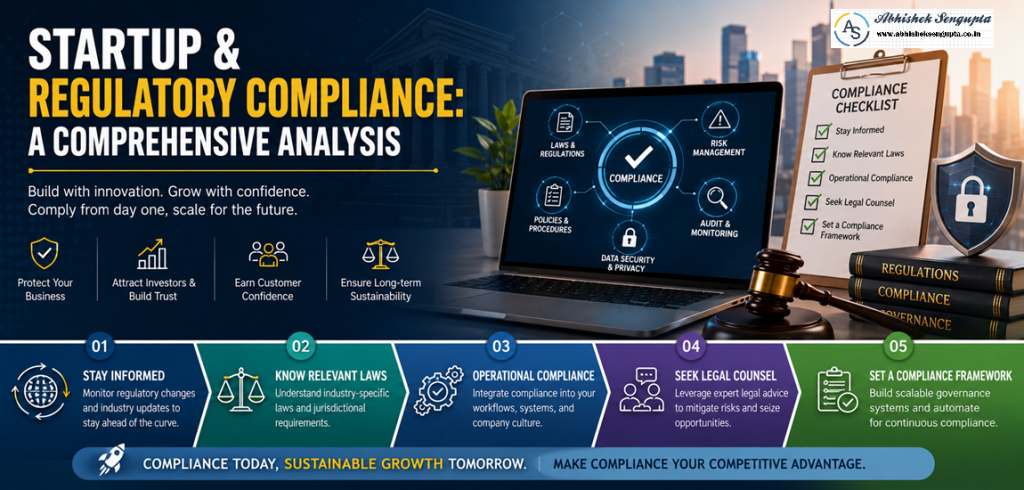
Pic - AI Generated
Starting a business is an exciting experience. It is powered by late-night brainstorming sessions, the pleasure of product-market fit, and an unwavering desire to tackle difficult challenges. In this fast-paced environment, founders are naturally drawn to product development, customer acquisition, and fundraising.
However, there is a silent partner in every venture that demands seats at the boardroom table from day one: regulatory compliance.
Many early-stage founders see compliance as a bureaucratic burden that will be addressed “later,” when the company has more funding and a dedicated legal team. This is a harmful misconception. Compliance is not a secondary issue in today’s venture ecosystem; rather, it is a critical structural pillar.
Failure to comply with applicable laws and regulations does not result in a simple slap on the wrist. It can result in massive fines, personal accountability for directors, insurmountable friction during investor due diligence, and even forced closures.
This guide provides a comprehensive path for startup owners navigating the regulatory jungle. We’ll look at why compliance matters, the five key components of a good compliance plan, and five real-world company case studies. These instances demonstrate how multinational startups either used compliance to gain market domination or failed catastrophically owing to its neglect.
Why Regulatory Compliance Matters ?
Regulatory compliance is the process of following to federal, state, and international laws, industry-specific rules, and ethical standards that apply to your business operations. It affects every aspect of your firm, including how you collect user data, reward your first intern, categorize revenue, and market your product.
For startups, proactive compliance is a major competitive advantage for four core reasons:
1. Avoidance of Catastrophic Capital Drain
Early-stage startups operate in a state of perpetual cash constraints. Every dollar must be optimized for growth.
When a regulatory agency assesses a fine, it is not based on your pre-revenue state or existing runway; rather, it is determined by legislative frameworks. A single large infraction might deplete a startup’s seed funding overnight. Furthermore, the legal fees required to challenge regulatory actions frequently outweigh the penalty, forcing otherwise viable firms into involuntary bankruptcy.
2. Institutional Investor and Due Diligence Readiness
The venture capital landscape has become very risk-averse. During Series A and Series B due diligence, institutional investors use specialized legal teams to examine a startup’s capital structure, intellectual property, employment history, and regulatory position.
If a venture capital company discovers systematic compliance holes, such as misclassified contractors, uncontrolled data privacy vulnerabilities, or operating without required financial licenses, they will either walk away from the acquisition or drastically reduce your valuation to compensate for the legal risk. Proactive compliance increases your company’s investability.
3. Customer Trust and Market Acceleration
Whether you are a B2B SaaS business selling to enterprise clients or a B2C application aimed at mainstream consumers, market access is totally dependent on trust.
Enterprise buyers will conduct rigorous security and compliance assessments on your software. If you cannot submit a SOC 2 Type II report, evidence of GDPR preparation, or industry-specific certifications, your enterprise sales cycle will be halted forever. Displaying robust compliance certifications, on the other hand, sends out an elite trust signal that boosts sales velocity and supports premium pricing.
4. Long-Term Corporate Sustainability and Founder Protection
A startup based on regulatory shortcuts is a house of cards. Your regulatory surface area grows rapidly in proportion to your transaction volume, user base, and public prominence. When you reach 100,000 users, what went unnoticed with 100 users will be flagged automatically or whistleblower actions will be initiated.
Crucially, corporate coverings do not always protect founders. In many jurisdictions, regulatory organizations can pierce the corporate veil and hold CEOs personally accountable for purposeful non-compliance, notably in cases of financial fraud, egregious labor violations, or extreme data carelessness.
Key Steps to Ensure Regulatory Compliance
1. Stay Informed: Tracking the Regulatory Horizon
Regulatory landscapes are dynamic ecosystem networks, not fixed monuments. Laws evolve in reaction to macroeconomic changes, geopolitical tensions, and technological advances.
A compliance structure that was perfectly legal last year may be entirely non-compliant today. To keep informed, a startup entrepreneur must create a disciplined internal monitoring system.
The Dynamic Nature of Modern Legislation
We are currently living through an unprecedented wave of regulatory updates, driven heavily by the rise of artificial intelligence, decentralized finance, and cross-border digital trade. Startups cannot afford to be reactive. You must maintain continuous situational awareness regarding:
- Geopolitical Data Manifests: Tracking how international data transfers are governed as countries constantly alter data residency and sovereignty requirements.
- Employment Law Metamorphosis: The criteria separating independent contractors from full-time employees are shifting rapidly across various regions, directly impacting startup gig-economy designs and remote-work architectures.
- Macro Tax Recalibrations: Digital services taxes, localized sales taxes (like economic nexus laws in the US), and cross-border VAT obligations change frequently, impacting automated billing engines.
Operationalizing Regulatory Intelligence
To prevent compliance tracking from consuming all your time, automate your intelligence gathering.
- Regulatory Aggregators: Use platform tracking tools like FiscalNote, OpenStates, or sector-specific tracking feeds to get real-time alerts on pending bills.
- Legal Updates & Institutional Feeds: Subscribe to updates from major law firms that focus on technology and startups. Monitor publications directly from regulatory bodies like the FTC, SEC, CFPB, or European Data Protection Board (EDPB).
- Industry Networks: Join trade associations and founder networks within your industry sector. These groups often run legal committees that share collective knowledge on upcoming legislative shifts.
Case Study 1: Meta (Data Protection & The Shift from Safe Harbor to Privacy Shield and Schrems II)
The most instructive example of how failing to track and adapt to shifting international regulatory frameworks can lead to massive consequences is the decade-long data transmission battle fought by Meta (formerly Facebook).
The Context & Shifting Ground
For years, hundreds of computer startups and tech behemoths depended on the EU-US Safe Harbor arrangement to securely move European user data to US-based servers for processing. Max Schrems, a privacy campaigner, sued Facebook Ireland in 2013, claiming that US surveillance laws made it impossible for American corporations to provide effective security against government data access for European citizens.
In October 2015, the European Court of Justice (ECJ) announced the landmark Schrems I decision, which immediately rendered the Safe Harbor system unlawful.
Suddenly, the legal foundation for thousands of transatlantic internet company models crumbled. A successor framework, the EU-US Privacy Shield, was immediately established, but it, too, was overturned in July 2020 by the Schrems II ruling. The court determined that standard contractual clauses (SCCs) required significantly more stringent risk evaluations and extra security measures to be valid.
The Consequence of Inertia
Meta continued transferring data across the Atlantic, betting that political negotiations would resolve the impasse before regulators issued penalties. This was an incredibly costly gamble.
In May 2023, the Irish Data Protection Commission, acting on instructions from the European Data Protection Board (EDPB), handed Meta a record-breaking €1.2 billion ($1.3 billion) fine. On top of the fine, Meta was ordered to stop transferring European user data to the United States and bring its operations into compliance within six months.
Key Takeaway for Founders
If a company as huge as Meta experiences massive disruptions and billion-dollar penalties as a result of changing cross-border legislation, an early-stage startup using the same path will be destroyed instantaneously.
Founders must design their data architectures, cloud infrastructure, and product workflows around worst-case regulatory scenarios. If your business operates globally, you must continuously track cross-border legal frameworks. You need to build a modular product that can adjust its data processing locations instantly if a treaty or data pact is struck down.
2. Know Relevant Laws: Industry-Specific Jurisdictions
Before you create a single line of code, purchase a domain name, or approach an angel investor, you must first identify the precise legal frameworks that govern your space.
Many innovators fall victim to the “Uber Fallacy,” which holds that if your technology is disruptive enough, you may disregard established industry laws and force regulators to conform to you. While that technique worked for a well-funded Uber a decade ago, today’s regulatory climate is far more stringent. Modern regulators are exceedingly tech-savvy and will quickly shut down firms that violate consumer safety regulations.
Let’s break down the primary regulatory compliance landscapes across the dominant sectors of the startup ecosystem:
The FinTech Space
FinTech startups operate under intense regulatory scrutiny because they handle the movement, storage, and management of capital. The primary frameworks include:
- AML & KYC (Anti-Money Laundering and Know Your Customer): Mandated by bodies like FinCEN in the US or the FCA in the UK. Startups must verify the identity of their users to prevent money laundering, terrorist financing, and financial fraud. This requires implementing robust identity verification funnels, sanction-list screening, and suspicious activity reporting (SAR) systems.
- PSD2 & Open Banking: In Europe, the Revised Payment Services Directive dictates how third-party providers access consumer bank data, requiring strict authentication protocols and secure APIs.
- PCI-DSS (Payment Card Industry Data Security Standard): While not a government law, this mandatory industry standard applies to any startup processing, storing, or transmitting credit card information. Non-compliance leads to immediate termination of merchant processing accounts.
The HealthTech & MedTech Landscape
Building products in the healthcare space means navigating a complex web of patient safety and data privacy laws.
- HIPAA (Health Insurance Portability and Accountability Act): In the US, any startup handling Protected Health Information (PHI)—whether you are an AI diagnostic app, a telemedicine platform, or a healthcare CRM—must comply with HIPAA. This requires data encryption both at rest and in transit, strict access controls, signed Business Associate Agreements (BAAs) with vendors, and comprehensive audit trails.
- GDPR (Article 9 Special Category Data): Under European law, health data is classified as special category data. Processing it requires explicit user consent, heightened security measures, and a clearly documented legal basis.
- FDA & CE Mark Clearance: If your software acts as a medical device (SaMD)—such as an AI model analyzing radiology scans to detect tumors—you cannot launch without clearance from the US Food and Drug Administration (FDA) or European CE Mark certification.
The E-Commerce & Marketplaces Sector
Digital retail startups face a complex mix of consumer protection laws, cross-border trade rules, and localized tax obligations.
- Sales Tax Nexus (Wayfair Decision): In the United States, the Supreme Court’s South Dakota v. Wayfair ruling established that e-commerce startups can trigger sales tax collection obligations in states where they have no physical presence, based entirely on transaction volumes or revenue totals.
- FTC Consumer Protection Rules: The Federal Trade Commission regulates online reviews, clear pricing disclosures, subscription cancellation policies (the “click-to-cancel” rules), and deceptive marketing practices.
Case Study 2: Zenefits (Insurance Licensing and Regulatory Evasion)
The story of Zenefits, a human resources SaaS startup launched in 2013, stands as a classic warning about what happens when a company tries to bypass industry-specific licensing laws in pursuit of hyper-growth.
The Business Model Innovation
Zenefits provided its HR cloud software to small enterprises free of charge. Instead of collecting software subscription fees, Zenefits made money by acting as the insurance broker of record for businesses that purchased health insurance plans for their employees through the platform. This innovative monetization strategy propelled the company to a $4.5 billion valuation in under two years.
The Regulatory Mistake
To sell health insurance legitimately in the United States, brokers must be licensed in each state where they operate. This process entails completing dozens of hours of necessary pre-licensing instruction and passing demanding state examinations.
Under pressure to scale its sales team as quickly as possible, Zenefits took illegal shortcuts. The company’s founder and CEO went so far as to create a custom macro—a software tool known as “the Macro”—that enabled Zenefits staff to pass California’s mandated 52-hour online insurance training course in a fraction of the time.
As a result, unlicensed salespeople sold millions of dollars worth of insurance policies to naïve small businesses.
The Fallout
In late 2015, the truth came out. State insurance regulators launched sweeping investigations into Zenefits’ operations. The fallout was immediate and devastating:
- The founding CEO was forced to resign in disgrace.
- The company was hit with millions of dollars in fines from insurance commissioners across dozens of states (including a $7 million fine in California alone).
- To avoid total collapse, Zenefits had to restructure its investor deals, cutting its valuation from $4.5 billion down to $2 billion.
- The company had to spend massive amounts of capital laying off staff, retraining employees, and building expensive internal compliance engines from scratch.
Key Takeaway for Founders
Technology can improve a current regulatory workflow, but it cannot go beyond legal obligations. If your company model is based on regulated transactions (such as insurance, securities, lending, or healthcare), your software cannot be utilized to avoid licensing requirements. Ensure that every employee and automated system functions entirely within the applicable legal framework from the start.
3. Operational Compliance: Weaving Legal Care into Product Design
Operational compliance means taking abstract legal texts and translating them into clear, actionable rules for your everyday business processes, software code, and workplace habits.
It ensures that compliance is baked directly into your startup’s culture, rather than being treated as a superficial checkbox exercise.
Building the Entity and Cap Table
Operational compliance begins with the physical formation of your corporate entity.
- Avoid Informal Partnerships: Don’t operate as a loose partnership or an unformed sole proprietorship. Register your business early as a Delaware C-Corp (the standard for venture-backed tech startups) or an LLC. This structure creates a clean legal shield separating your personal assets from your business liabilities.
- IP Assignment Agreements: Ensure every co-founder, early employee, and independent contractor signs an explicit Invention Assignment Agreement before they write a single line of code. This guarantees that all intellectual property belongs entirely to the corporate entity, keeping your asset portfolio clean for future investors.
- Automated Cap Table Management: Avoid tracking your equity splits on messy, manual spreadsheets. Use modern equity platforms like Carta or Pulley to automate option pools, vestings, and stock issuances. This keeps your cap table accurate and prevents costly disputes with early hires.
Data Privacy by Design
In the digital economy, your data collection workflows are heavily scrutinized by regulators. Under frameworks like GDPR and CCPA, you must design your software platforms using the principle of Data Privacy by Design:
- Data Minimization: Do not collect data you don’t strictly need. If your app doesn’t require a user’s location or date of birth to function, do not collect or store it. Minimizing your data footprint lowers your regulatory risk.
- Dynamic Consent Engines: Replace pre-checked opt-in boxes and hidden privacy policies with clear, active consent banners. Give users easy ways to manage their cookie choices and request data deletion (“the right to be forgotten”).
- End-to-End Security Encryption: Treat user data like liquid gold. Use strong encryption protocols for data at rest and in transit, implement multi-factor authentication (MFA) across all company accounts, and run regular penetration testing on your code.
Workplace Operations and Labor Law
Your team is your most valuable asset, but improper workplace practices can expose your startup to serious labor lawsuits.
- Independent Contractors vs. Full-Time Employees: Do not classify a worker as an independent contractor (1099) simply to avoid paying healthcare benefits, payroll taxes, or overtime fees if they are actually functioning as a full-time employee (W2). Regulators use strict multi-factor tests to check worker classifications, evaluating things like your level of behavioral control and financial dependence.
- Clear HR Policies: Create a comprehensive Employee Handbook that clearly outlines company anti-harassment rules, whistleblower protections, and clear remote-work policies from the moment you hire your first employee.
Case Study 3: Hippo Insurance (Operational Resilience During Rapid Expansion)
On the positive side of compliance management stands Hippo Insurance, an InsurTech startup founded in 2015 that modernized home insurance through automation, IoT integrations, and real-world data analytics.
The Compliance Challenge
The US homeowners insurance sector has a highly complicated regulatory framework. Insurance is regulated on a state-by-state basis, with each state having its own independent insurance commissioner, capital reserve requirements, policy approval standards, and consumer disclosure legislation.
To fulfill its aim of rapid national expansion, Hippo needed more than just a fantastic digital interface; it needed to figure out how to spread across 50 distinct legal jurisdictions without breaching the law or reducing underwriting quality.
The Strategy: Compliance Built into Operations
Hippo didn’t try to challenge or bypass state insurance departments. Instead, they built a highly flexible compliance engine directly into their software stack and business development strategy:
- The MGA (Managing General Agent) Model: Hippo launched as a licensed Managing General Agent. This allowed them to design policies and handle underwriting using their advanced software, while partnering with established insurance giants to utilize their massive balance sheets and existing state regulatory filings. This smart structure dramatically speeded up their time-to-market.
- Strategic Acquisition (Spinnaker Insurance): In 2020, rather than spending years applying for individual carrier licenses state-by-state, Hippo acquired Spinnaker Insurance Company, a highly respected national carrier licensed across all 50 states. This move instantly embedded a robust, compliant corporate infrastructure into their tech platform.
- Modular Product Engineering: Hippo built its software platform with modular rules engines. When expanding into a new state, developers didn’t have to rewrite the core application; they simply updated local parameters to match that state’s specific policy limits, required disclosures, and pricing rules automatically.
The Outcome
Hippo was able to successfully scale across the United States by adhering to regulatory standards and adapting its basic operations accordingly. They became public in 2021 through a SPAC merger, solidifying its position as a significant player in the InsurTech field. its proactive approach to compliance shielded them from the regulatory fines and closures that bankrupted many of its competitors.
4. Seek Legal Counsel: Maximizing Strategic Legal Support
A common mistake made by founders is to treat legal support as a costly emergency service, to be called only when they receive a cease-and-desist letter or a regulatory subpoena.
In reality, clever entrepreneurs see legal guidance as a significant strategic advantage. Experienced attorneys can help you manage difficult transactions, avoid typical errors, and identify lucrative market opportunities before they become problems.
The True Cost of Delaying Legal Support
Many cash-strapped founders try to handle legal tasks themselves using basic internet templates for corporate bylaws, terms of service, and employment contracts. This often leads to hidden legal flaws that can hurt the company later:
- Defective Cap Tables: Misunderstanding stock exemptions can cause major legal issues when issuing equity to early employees, which can stall future funding rounds.
- Vague IP Assignments: Simple contract templates from the web often lack the exact legal phrasing needed to completely transfer intellectual property ownership from a contractor to your company, leaving your core technology vulnerable.
- Weak Indemnification Terms: Standard commercial contracts without proper liability caps can expose your startup to massive financial damages if a customer suffers a product failure.
Smart Ways for Startups to Use Legal Resources
You don’t need a massive legal team on a high retainer right away. Instead, use modern, flexible legal services designed for growing companies:
- Fractional General Counsels: Hire experienced, part-time legal executives who understand startups. They can attend your strategic meetings and oversee your legal strategy for a fraction of the cost of a full-time hire.
- Specialized Law Firms: Avoid general local lawyers. Partner with established firms that specialize in technology startups and venture capital. They can offer fixed-price legal packages for early incorporation and document setups, giving you predictable costs.
- Strategic Legal Tech Stack: Streamline your everyday legal work by using modern contract management tools.
Case Study 4: Robinhood (Gamification, Platform Outages, and Retainer Penalties)
The growth story of Robinhood, the digital brokerage startup launched in 2013, highlights the massive risks of letting your product development speed outpace your legal and compliance oversight.
The Rapid Growth Engine
Robinhood significantly changed the retail investment landscape by delivering zero-commission trading via a highly accessible, mobile-first interface. This user-friendly interface made the financial markets accessible to millions of first-time investors, resulting in a tremendous increase in user acquisition during the pandemic market bubble of 2020.
The Compliance Gaps
Robinhood’s product design team focused heavily on user growth and high engagement, but they didn’t scale their legal, compliance, and infrastructure support at the same rate. This led to serious operational and regulatory failures:
- Systemic Network Outages: During periods of extreme market volatility in March 2020, Robinhood’s platform suffered severe, multi-day outages. Users were locked out of their accounts and couldn’t execute trades, losing millions of dollars while the market swung wildly.
- Flawed Options Approvals: The platform used automated approval algorithms that mistakenly granted high-risk options trading access to thousands of retail investors who did not meet the required financial profile or experience levels.
- Inadequate Customer Support: The company relied almost entirely on automated email responses, lacking a live, real-time customer support team to handle critical financial account emergencies.
The Regulatory Penalties
In June 2021, the Financial Industry Regulatory Authority (FINRA) handed Robinhood a $70 million penalty—the largest fine in the organization’s history.
FINRA’s investigation found that Robinhood had given users misleading information, failed to properly oversee its automated technology systems, and neglected its core brokerage obligations. On top of the heavy fine, Robinhood had to pay tens of millions of dollars in restitution to affected customers, expand its legal and compliance teams at a premium, and overhaul its entire system infrastructure under intense regulatory oversight.
Key Takeaway for Founders
If your product involves user finances, investments, or key operations, your legal and technical teams must coordinate their efforts. Growth metrics are meaningless if your platform architecture is unable to handle traffic properly. Prior to launching your scaling engine, consult with legal counsel to assess your automated workflows, system reliability, and customer support methods.
5. Set a Compliance Framework: Scaling Corporate Governance Proactively
As a startup grows past the seed stage, compliance can no longer be handled informally by the co-founders on weekends. You need to transition to a structured, internal Compliance Framework.
This means setting up permanent systems that monitor operations, catch risks early, and ensure every employee follows the rules naturally.
Building Your Framework Step-by-Step
A scalable startup compliance program relies on four main pillars:
1. Appoint Internal Ownership
Do not leave compliance in a vague “everyone’s responsibility” bucket. Assign clear ownership. In the early stages, this might be your Head of Operations or VP of Engineering.
As you approach your Series A or B round, hire a dedicated Chief Compliance Officer (CCO) or Risk Director who reports directly to the CEO and board of directors, ensuring they have the authority to enforce necessary changes.
2. Implement Automated Internal Audits
Avoid relying entirely on slow, manual year-end reviews. Use modern compliance automation platforms (such as Vanta, Drata, or Secureframe) to connect directly to your tech tools, cloud providers, and HR apps.
These platforms run automated checks 24/7, flag security gaps instantly, and help you collect the continuous evidence needed for SOC 2, ISO 27001, or HIPAA reviews with minimal friction.
3. Establish Whistleblower Channels
Many damaging corporate scandals start because junior employees spot serious compliance issues but feel they have no safe way to raise the alarm internally.
Set up secure, completely anonymous reporting channels where team members can flag legal or ethical concerns directly to senior leadership or the board without fear of professional backlash.
4. Run Recurring Training Sessions
A compliance policy is only useful if your team actually understands and follows it. Move away from long, boring legal PDFs that employees sign once and forget.
Instead, run short, interactive training sessions that explain the practical “why” behind your security rules, data handling guidelines, and industry standards.
Case Study 5: Theranos (The Ultimate Governance and Compliance Collapse)
There is no more striking example of a total collapse in corporate governance and compliance than Theranos, the health technology startup founded by Elizabeth Holmes in 2003 that promised to revolutionize blood testing.
The False Promise
Theranos claimed that their patented Edison devices could perform hundreds of advanced medical tests with just a few drops of blood obtained from a simple finger prick. This invention promised to make blood testing cheaper, faster, and less painful, propelling the business to a $9 billion value with support from high-profile investors and large retail partners.
The Deceptive Culture
In reality, Theranos’ technology did not work. The Edison machines were inaccurate, inconsistent, and failed basic medical validation checks. To hide these failures, the company set up a deeply toxic corporate culture completely devoid of compliance and ethical guardrails:
- Bypassing Regulatory Standards: The company hid its real testing workflows from federal inspectors and secretly ran its patient samples on modified, standard commercial testing machines bought from third-party competitors.
- Silencing internal experts: When internal scientists, lab technicians, and data analysts warned leadership that the test results were dangerously inaccurate, they were fired, threatened with lawsuits, or forced to sign strict non-disclosure agreements.
- Total Lack of Independent Board Oversight: Theranos built a star-studded board of directors filled with prominent retired politicians and military generals. While these individuals had impressive public careers, they lacked any background in medicine, clinical science, or healthcare compliance, leaving them unable to properly audit the company’s real technology.
The Destruction
In late 2015, investigative journalist John Carreyrou broke the story open in the Wall Street Journal. The exposure triggered a swift and complete operational collapse:
- Federal health regulators (CMS) swept in, stripped the laboratory certifications, and banned Holmes from operating any clinical labs.
- The SEC filed charges for massive fraud, and the company was completely dissolved in 2018.
- The founder and chief operating officer were both convicted of federal wire fraud and conspiracy, resulting in lengthy federal prison sentences.
- Investors lost billions of dollars, and more importantly, thousands of patients received dangerously incorrect medical lab results that actively put their health at risk.
Key Takeaway for Founders
Compliance is fundamentally concerned with integrity, safety, and realism. If a startup fosters a culture that silences internal critics, deceives regulators, and avoids independent audits, it will eventually fail totally.
True corporate governance necessitates the creation of an open, honest culture in which problems are addressed openly, independent experts check your technology, and compliance is viewed as a fundamental rule rather than an impediment to be avoided.
Regulatory compliance – Not to be ignored
Regulatory compliance is not an administrative afterthought that can be postponed; it is a fundamental building block for creating a sustainable, venture-scale business.
The “move fast and break things” mindset, which dominated the early tech boom, has matured. In today’s market, successful founders are those who act quickly while establishing a solid, legal base.
By prioritizing compliance from the start, you safeguard your startup from catastrophic penalties, streamline investor due diligence, and create a long-lasting brand trusted by customers, partners, and the wider market.
Key Takeaways
- Stay Ahead of Changing Rules: Set up clear, automated internal systems to monitor shifting laws across your target markets.
- Respect Local Jurisdictions: Never assume a great product allows you to bypass local licensing, consumer safety, or data privacy laws.
- Build Security into Product Design: Bake compliance controls directly into your software engineering, databases, and HR workflows.
- Invest in Legal Support Early: Treat your legal counsel as a key strategic partner that helps you unlock new deals and avoid hidden traps.
- Automate Governance as You Scale: Move away from manual checks and use continuous compliance platforms to keep your systems audit-ready.
Are you ready to sustainably scale your venture? From the beginning, make compliance a top focus in your organization!




More Blogs
Adapting to Change: A Challenge for Startups
Accessing New Markets: A Challenge for Startups
Sustaining a Startup Founder’s Motivation