


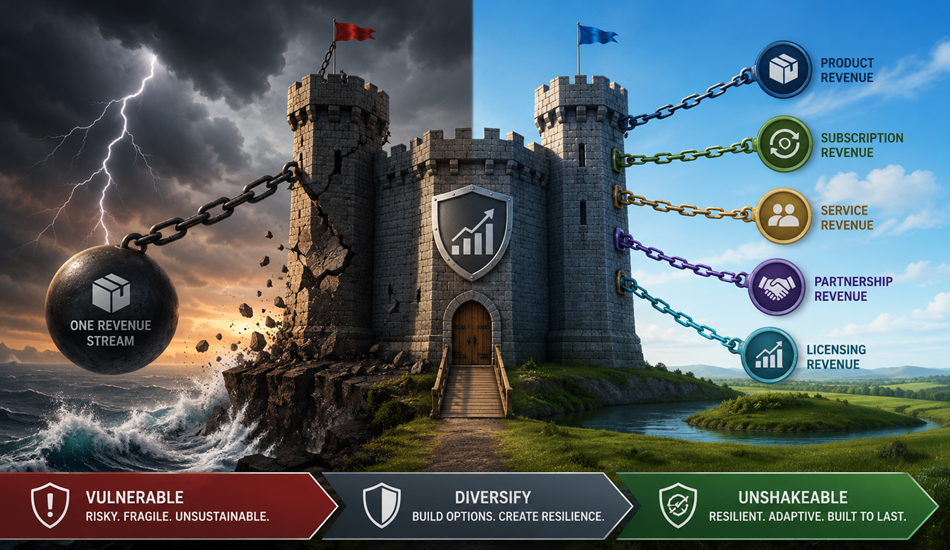
Pic AI Generated
For any business founder, the appeal of a single, lucrative income stream is indisputable. It is the actual, monetary evidence that your main product or service is well-liked by consumers—the ultimate affirmation you desire for. When the growth curve is vertical, doubling down on what works feels like the only rational approach. Your internal metrics appear flawless, you have the support of venture funders, and your operational focus is unwavering.
Extreme attention, however, can easily cross the line into perilous vulnerability in the world of high-growth business. There is a high stakes gamble gamble gamble gamble gamble gamble gamble gamble gamble gamble gamble gamble gamble gamble gamble gamble gamble gamble gamble gamble. There are several examples throughout history of well-funded, promising businesses that fell apart practically overnight when their main revenue stream dried up as a result of unanticipated changes.
Your startup’s survival is dependent on factors that are completely out of your control when you rely on a single source of income. True company resilience is about how well you can withstand an unexpected storm, not just how quickly you can expand during a market boom.
You must switch from a brittle single-stream structure to a diversified revenue strategy if you want to create a long-lasting firm. This thorough handbook, which is supported by both historical and current case studies of corporate survival and failure, breaks down the fundamental structural hazards of single-stream dependency and offers a workable, real-world framework for diversification.
Part 1: The Anatomy of Risk – Why Single-Stream Dependency is Dangerous
Understanding the fundamental weaknesses in a concentrated revenue model is the first step towards successfully diversifying. A startup lacks structural redundancy when it relies on a single product, clientele, or revenue source. The entire company comes to a standstill if just one engine fails.
Let’s examine the five core risks that make single-stream dependency highly dangerous for startups and scale-ups alike.
1. Market Volatility
Understanding the fundamental weaknesses in a concentrated revenue model is the first step towards successfully diversifying. When a market shifts, consumer wallet share contracts, business budgets get reduced, and overnight, your major customer base may no longer have the capital or the desire to acquire your service. Your revenue immediately falls to zero if you don’t have any other ways to capture value.
Case Study: Zynga and the Facebook Platform Shift (2011–2012)
In the early 2010s, Zynga was the undisputed titan of social gaming. Propelled by hits like FarmVille, Mafia Wars, and CityVille, the company enjoyed a meteoric rise, culminating in a massive IPO in December 2011. However, Zynga’s spectacular growth was built on a fragile foundation: an almost absolute reliance on a single revenue stream tightly coupled with Facebook’s desktop platform. Zynga generated income by selling virtual goods within games hosted on Facebook, relying entirely on Facebook’s notifications and news feed algorithms to acquire and retain users.
In 2012, the landscape shifted dramatically. Consumer behavior migrated rapidly from desktop web browsers to mobile devices. Simultaneously, Facebook systematically altered its platform policies and algorithms. To improve user experience and monetize its own platform via mobile ads, Facebook throttled the free virality that Zynga’s games relied on, making it significantly harder for Zynga to ping users with game updates.
Because Zynga’s revenue engine was entirely dependent on Facebook’s ecosystem, the impact was immediate and devastating. Within months of its IPO, Zynga’s active user numbers plummeted, bookings dropped sharply, and the stock lost approximately 75% of its value. Zynga had failed to proactively diversify its distribution channels and monetization models into standalone mobile environments. The company spent years burning through cash reserves to acquire mobile studios (like the $527 million acquisition of NaturalMotion) just to buy back the diversified market positioning it should have built organically.
2. Competitive Pressure
In a free-market system, outsized profits attract hostile competitors. Well-capitalized incumbents or nimble, imitation startups will undoubtedly take note if your firm is the first to develop a profitable single-revenue engine. They can provide disruptive breakthroughs that make your single product outdated, undercut your pricing through venture-subsidized losses, or duplicate your main offering. You end up in a race to the bottom if you don’t have a diverse ecosystem of goods or services to keep customers and preserve profits.
Case Study: BlackBerry (Research In Motion) vs. The Smartphone Revolution (2007–2013)
Research In Motion (RIM), the creator of BlackBerry, once held a virtual monopoly on enterprise mobile communication. Its single, wildly profitable revenue engine was built on secure, physical-keyboard devices deeply integrated with enterprise email servers (BlackBerry Enterprise Server). For years, this single ecosystem generated massive recurring service fees and hardware margins. BlackBerry assumed its enterprise moat was completely unassailable.
In 2007, Apple introduced the iPhone, followed closely by Google’s Android ecosystem. These competitors disrupted the market by shifting the value proposition from a pure communication tool to an open, software-driven application platform. BlackBerry dismissed the iPhone as a fragile “toy” with poor battery life and lacking a physical keyboard.
However, consumers and enterprise employees fell in love with touchscreens and app ecosystems, driving the “Bring Your Own Device” (BYOD) trend in corporate IT. Competitors rapidly matched BlackBerry’s security features while offering vastly superior software flexibility.
Because BlackBerry was overly reliant on its legacy hardware-plus-service revenue model and failed to diversify into modern consumer software, media, or cloud services early enough, its market share collapsed. RIM’s global smartphone market share plummeted from over 20% in 2009 to less than 1% by 2014, forcing a painful, multi-year pivot into enterprise software and cybersecurity just to survive.
3. Customer Churn
Customer tastes change rapidly. Relying on a single customer segment or a few large anchor customers exposes your firm to significant turnover rates. If your target segment experiences financial difficulties, discovers an alternative option, or sees a cultural shift, your earnings could vanish in an instant. With a high customer concentration inside a single revenue stream, losing only a few customers can risk your entire payroll.
Case Study: Chillingo and the Vulnerability of Indie Game Publishing (2010s)
Chillingo was a premier mobile game publisher in the early days of the iOS App Store, famous for publishing hyper-successful indie hits like Angry Birds (by Rovio) and Cut the Rope (by ZeptoLab). Chillingo’s primary revenue stream was a percentage split of premium app downloads and early in-app purchases from these third-party developed games.
However, Chillingo’s business model suffered from severe customer concentration and churn vulnerability. They did not own the underlying Intellectual Property (IP) of their biggest hits; they merely published them. Once Rovio achieved massive global success with Angry Birds, they realized they no longer needed a middleman publisher. Rovio took their subsequent titles and massive merchandising ecosystem completely in-house, cutting Chillingo out of the revenue loop. ZeptoLab quickly followed a similar path with Cut the Rope.
Because Chillingo relied heavily on a fluctuating roster of independent developers without cultivating a diversified portfolio of wholly-owned IP, recurring SaaS tools, or platform services, their revenue stream proved highly volatile. When their anchor developers left the nest, Chillingo was hit with catastrophic churn that simple indie hits couldn’t patch, illustrating how fragile a business is when its revenue depends entirely on the loyalty of a few external partners.
4. Lack of Scalability
A single revenue stream will always reach a limit set by the total addressable market (TAM) of that particular specialty. Your growth rate will stall once you reach substantial penetration in that single market segment, regardless of how much capital you invest in sales and marketing. True, sustainable scalability necessitates expanding into adjacent markets, revealing latent value within your existing client base, and developing new entry points for purchasers who cannot afford or do not require your main product.
Case Study: GoPro and the Limitations of the Capture-Device Market (2014–2017)
GoPro built a phenomenal business by creating the world’s best action cameras. When the company went public in 2014, it was valued at billions of dollars on the back of spectacular hardware sales growth. However, GoPro’s revenue model was intensely concentrated: they sold premium, durable physical cameras to outdoor enthusiasts, athletes, and videographers.
The core issue emerged post-IPO: GoPro cameras were too good and too durable. Customers who bought a GoPro Hero 3 or 4 had very little incentive to upgrade to a Hero 5 or 6 every single year, as the incremental hardware improvements plateaued. Furthermore, the addressable market of extreme sports enthusiasts was finite. Once GoPro sold a camera to nearly every surfer, skier, and skydiver in their core demographic, hardware sales growth ground to a halt.
Because GoPro was initially structured around this single hardware sales transaction, it hit a hard scalability wall. The company attempted to position itself as a media company, investing heavily in original content, but failed to monetize it. They also launched a drone (Karma) that suffered from severe technical recalls.
It wasn’t until GoPro systematically diversified into software subscriptions (offering cloud storage, automatic video editing, and damage protection plans for a recurring annual fee) that the business stabilized. By unlocking recurring software revenue from their existing hardware users, GoPro finally broke past the limitations of their single-stream hardware sales model.
5. Operational Instability
When your company is like a single-engine airplane, any operational failure might bring it down. Technical malfunctions, data breaches, unforeseen supply chain interruptions, or the loss of a key vendor can all block a single revenue stream. If you do not have alternate, operationally independent revenue sources pouring into your organization, even a minor disruption to your primary operation might cause an existential cash flow catastrophe.
Case Study: MoviePass and the Flawed Single-Price Subscription Model (2017–2019)
MoviePass is a textbook example of extreme operational instability caused by an un-diversified, deeply flawed revenue engine. In August 2017, MoviePass launched a disruptive subscription model: users could watch one movie per day in theaters for a flat monthly fee of $9.95. The company’s planned primary revenue stream was this low-cost subscription, with the expectation that they could eventually monetize user data, secure studio partnerships, and cut profit-sharing deals with major theater chains for concessions.
The fatal flaw was that MoviePass had to pay theater chains the full, retail face value of every single ticket its subscribers ordered. If a user in New York or Los Angeles watched just one movie a month, MoviePass lost money on that subscriber. As their user base exploded to millions of subscribers, their cash burn rate became unsustainable.
Worse, major theater chains like AMC flatly refused to share concession revenues or offer ticket discounts. MoviePass had no secondary revenue streams—no advertising network, no proprietary digital content, and no alternative monetization mechanics—to offset the massive operational losses of their core subscription.
When the cash crunch intensified, MoviePass suffered catastrophic operational breakdowns. They were forced to change pricing terms arbitrarily, throttle ticket availability, and pull major film releases from the app. At one point in July 2018, the company literally ran out of money and had to secure an emergency $5 million loan just to turn their mobile app back on after a multi-hour outage. Because the business had no structural redundancy or alternative income channels to lean on while negotiating with theaters, this operational instability quickly led to bankruptcy and liquidation.
Part 2: Building a Fortress – Strategies for Revenue Diversification
To protect your startup from these vulnerabilities, you must proactively develop a diverse income strategy. Diversification does not imply haphazardly creating unrelated businesses; rather, it entails proactively designing additional income streams that capitalize on your core capabilities, brand equity, and existing client relationships.
Let’s explore four primary paths to successful revenue diversification, complete with tactical execution frameworks and real-world case studies for each.
Strategy 1: Expanding Your Product/Service Portfolio
The first logical step in diversification is looking inward at your existing operational capabilities and outward at your current user base to identify opportunities for portfolio expansion.
Identify Adjacent Markets
Analyze your current customers to discover related pain points. What happens immediately before or right after they use your product? By mapping the entire user journey, you can identify logical, adjacent products or services that solve these surrounding problems, allowing you to capture a larger share of their overall budget.
Tiered Offerings
If you sell a uniform product, you are likely leaving money on the table at both ends of the spectrum. Introducing distinct pricing tiers allows you to capture value across a much broader spectrum of demand.
- Basic/Entry tiers lower the barrier to entry for price-sensitive customers.
- Premium/Enterprise tiers unlock advanced security, custom integrations, or dedicated support for high-budget corporate clients who require more robust solutions.
New Product Lines
Develop entirely new products that build on your existing core competencies, technological infrastructure, or manufacturing capabilities. This approach lets you enter completely new industries or target entirely different demographics, insulating your business from a sudden downturn in your legacy market.
Case Study: Apple’s Shift from Hardware to Services (2015–Present)
By 2015, Apple was generating the vast majority of its revenue and profits from a single hardware device: the iPhone. The iPhone was an unprecedented cash cow, but Wall Street grew deeply anxious. Global smartphone saturation was looming, upgrade cycles were lengthening, and low-cost Android competitors were closing the hardware quality gap. If iPhone sales peaked or declined, Apple’s entire corporate growth story would stall.
In response, Apple executed one of the most successful product portfolio diversification strategies in corporate history. They systematically focused on building out their Services portfolio, leveraging the massive global install base of active iPhone users. They launched and aggressively scaled Apple Music, iCloud storage tiers, Apple Pay, Apple Care, and eventually Apple TV+, Apple Arcade, and Apple Fitness+.
This strategy was brilliant because it transformed an upfront, transactional hardware relationship into a sticky web of high-margin, recurring subscription revenues. If a consumer decided to keep their iPhone for three years instead of two, Apple could still monetize that user every single month through cloud storage, music streaming, and financial transaction fees.
By 2024, Apple’s Services division alone was generating over $85 billion in annual revenue—boasting gross margins above 70%, nearly double the margins of their hardware products. Apple transformed itself from a volatile consumer hardware manufacturer into a resilient, diversified ecosystem platform.
Strategy 2: Exploring Cross-Selling and Upselling
Once you have established a core customer base, your most efficient path to revenue growth is maximizing the Lifetime Value (LTV) of those existing accounts, rather than spending heavily on new customer acquisition.
Cross-Selling
Cross-selling is the art of offering complementary products or services that enhance the utility of the primary purchase. For instance, a software platform might cross-sell professional implementation services, customized template packs, or specialized training academies.
Upselling
Upselling focuses on moving an active customer up the value chain. This involves persuading them to transition from a self-serve tier to an assisted tier, or to purchase add-on premium features like advanced analytics, real-time alerts, automated workflows, or expanded user seats.
Bundling
Bundling wraps multiple distinct products, modules, or services into a single, cohesive package offered at an attractive combined price point. This increases the total transaction value while introducing users to wider areas of your product ecosystem that they might not have explored individually.
Case Study: Amazon and the Birth of Amazon Web Services (2000–Present)
In the late 1990s and early 2000s, Amazon was fundamentally a low-margin e-commerce retailer. Its single major revenue engine was online retail sales, which suffered from seasonal volatility and razor-thin net margins. To handle the massive, unpredictable traffic spikes of the holiday shopping season, Amazon had to build out an incredibly robust, scalable, and reliable internal technology infrastructure.
Realizing they had built a world-class internal capability for server management and data storage, Amazon’s leadership decided to cross-sell this infrastructure to the rest of the world. In 2006, they officially launched Amazon Web Services (AWS), allowing external software developers, startups, and enterprises to rent computing power and storage space on Amazon’s infrastructure.
This was an incredible cross-industry cross-sell. Amazon leveraged its internal cost center and transformed it into a completely independent, high-margin revenue engine. AWS grew to dominate the global cloud computing market.
Today, while e-commerce still drives the majority of Amazon’s top-line revenue, AWS regularly generates over 60% of Amazon’s total corporate operating profit. This highly profitable enterprise cloud business gives Amazon the financial security to invest heavily in logistics, hardware, streaming media, and physical retail, making the entire parent company incredibly resilient against retail market fluctuations.
Strategy 3: Implementing a Referral and Partnership Program
You do not have to build every new revenue stream entirely on your own. By designing structured partner networks, you can leverage third-party capital, audiences, and resources to build secondary revenue engines.
Incentivize Referrals
Transform your happiest customers into an organic sales force. By implementing structured referral mechanisms that reward existing users with cash back, service credits, or exclusive access when they bring in new verified buyers, you create a self-sustaining customer acquisition loop that lowers your average customer acquisition cost (CAC).
Affiliate Marketing
Form formal partnerships with industry influencers, content creators, media publications, and complementary business platforms. By offering a clean, trackable percentage commission on all net sales generated through their custom referral links, you tap into highly targeted audiences with built-in trust, paying only for verified conversions.
Strategic Partnerships
Identify non-competitive businesses that serve the exact same target demographic as you. By forming a strategic alliance, you can co-develop joint promotions, integrations, or bundled packages. This allows both organizations to cross-pollinate customer networks and share marketing costs, opening up entirely new revenue pipelines for both teams.
Case Study: HubSpot and the Agency Partner Program (2010–Present)
When HubSpot was a young SaaS company selling marketing automation software, they relied heavily on standard direct-sales models. However, direct inside-sales teams are expensive to scale, and software churn remains a constant threat if small business owners don’t know how to use the tool effectively.
HubSpot identified a vital partner ecosystem: independent digital marketing, SEO, and PR agencies. These agencies were already managing the marketing strategies and budgets for thousands of small and medium-sized businesses. HubSpot designed the HubSpot Agency Partner Program, incentivizing agencies to recommend HubSpot software to their entire client portfolios.
To make the partnership lucrative, HubSpot didn’t just offer simple affiliate payouts. They allowed agencies to white-label certain services, co-sell software, and build highly profitable managed-service retainers on top of the HubSpot platform. HubSpot provided agencies with extensive training, certifications, and exclusive co-marketing collateral.
The strategy paid off beautifully. The agency partner program grew to drive over 40% of HubSpot’s total revenue. By building a global network of motivated agency partners who acted as localized sales and implementation engines, HubSpot accelerated its global expansion, significantly reduced its long-term CAC, and drastically lowered customer churn—since clients are far less likely to cancel software that their trusted agency uses daily to run their business.
Strategy 4: Considering Alternative Revenue Models
Sometimes, true diversification requires changing how you charge for value. Shifting or expanding your business into alternative revenue models introduces structural stability to your balance sheet.
Subscription Models
If your business model relies entirely on one-time transactions, you start every single month at zero revenue. Introducing a subscription tier—whether for physical products, continuous service retainers, or software access—builds a reliable baseline of predictable, recurring revenue (ARR/MRR) that stabilizes cash flow and vastly improves your corporate valuation.
Freemium Models
The freemium model removes all friction from the top of your marketing funnel by offering a robust, free version of your product. This allows you to build a massive global user base organically. You then monetize the top tier of that audience by gating advanced features, enterprise security protocols, or automation capabilities behind a premium paywall.
Advertising Networks
If your platform generates deep user engagement and high daily traffic, you can monetize that attention by integrating targeted, privacy-compliant ad networks. This approach creates a secondary revenue stream funded by advertisers, keeping the platform affordable or completely free for your end users.
Licensing
If your startup has developed unique proprietary technologies, manufacturing processes, or content IP, you don’t have to be the only one using it. Licensing that IP to external organizations or non-direct competitors allows you to secure pure-profit, low-overhead royalty streams that drop straight to your bottom line.
Case Study: The New York Times Company and the Digital Subscription Pivot (2011–Present)
For over a century, traditional print newspapers relied on a classic dual-revenue model: print advertising space and physical newsstand/subscription sales. However, print advertising was historically the dominant profit engine. With the rise of the internet, Craigslist erased the classifieds section, Google and Facebook captured the digital display advertising market, and print readers migrated online for free news.
By the late 2000s, print advertising revenues across the newspaper industry collapsed. The New York Times Company faced a severe financial crisis, forcing them to take high-interest emergency loans just to avoid insolvency.
In March 2011, The New York Times introduced a metered digital paywall, launching a digital subscription model. This was a massive cultural shift; readers had grown accustomed to accessing online news completely free of charge. The company gave readers a handful of free articles per month before requiring a paid digital subscription.
The digital subscription model became an absolute fortress for the business. As ad markets remained highly volatile, their recurring digital subscription revenue grew consistently year after year.
The company expanded this model by creating separate, highly focused digital subscriptions for NYT Cooking, The Athletic (sports journalism), and NYT Games (monetizing viral hits like Wordle). By 2024, The New York Times surpassed 10 million total subscribers, with digital subscription revenues serving as the primary financial driver of the company. This pivot successfully insulated their newsroom from the collapse of traditional print advertising.
Part 3: Deep-Dive Case Study – The Evolution of Adobe Inc.
To truly understand how revenue diversification and strategic model transformations save a business from obsolescence, we can analyze the transformation of Adobe Inc. over the past two decades.
The Era of Boxed Software (Pre-2012)
For decades, Adobe was a highly successful software giant, famous for industry-standard creative tools like Photoshop, Illustrator, InDesign, and Premiere Pro. Adobe’s monetization model was strictly transactional: the company packaged its tools into the “Creative Suite” (CS) and sold them as perpetual licenses. Customers paid a massive, one-time upfront fee—often ranging from $1,200 to $2,500—for a physical box containing software discs.
While this single revenue engine generated billions of dollars, it suffered from severe structural vulnerabilities:
- Extreme Upfront Cost barriers: Solopreneurs, small design agencies, and students were completely priced out by the multi-thousand-dollar entry barrier, which fueled widespread software piracy.
- Unpredictable Upgrade Cycles: Adobe was trapped on an eighteen-month product development treadmill. To secure recurring revenue from existing users, they had to invent major new features every year and a half to convince people to pay hundreds of dollars for an upgrade. If a customer decided the current version was “good enough,” Adobe’s revenue from that user dropped to zero for that cycle.
- Macro-Economic Sensitivity: During economic downturns, corporate IT departments quickly frozen capital expenditure budgets, delaying software upgrades for years and creating massive revenue cliffs for Adobe.
The Pivot to Creative Cloud (2012–2015)
In 2012, despite fierce resistance from traditional customers and Wall Street analysts, Adobe’s leadership executed a bold strategy: they discontinued the traditional Creative Suite entirely and shifted their entire creative product portfolio to a cloud-based subscription model called Adobe Creative Cloud.
Instead of charging a $2,500 upfront fee, Adobe offered access to their entire suite of creative applications for a predictable monthly fee of approximately $50.
The initial financial transition was painful—a phase often referred to in corporate strategy as “swallowing the fish.” Top-line revenue temporarily dipped as massive upfront payments were replaced by smaller monthly subscription installments.
However, the strategic benefits quickly became clear. The low entry price made the software accessible to millions of new users, effectively crushing casual software piracy. Revenue became incredibly predictable, smoothing out the peaks and valleys of their financial quarters.
Expanding into Enterprise Data and Analytics
Adobe did not stop at simply converting their existing tools into subscriptions; they used this financial predictability to diversify into an entirely new market segment: enterprise marketing data and web analytics.
Through strategic multi-billion-dollar acquisitions—including Omniture (web analytics), Magento (e-commerce), and Marketo (marketing automation)—Adobe built a completely separate enterprise software arm known as the Adobe Experience Cloud.
This strategy transformed Adobe from a point-solution creative vendor into an enterprise platform. Today, Adobe doesn’t just sell design software to creative teams; they sell comprehensive marketing, data personalization, asset management, and analytics infrastructure to chief marketing officers (CMOs) and enterprise IT departments.
If a global enterprise cuts its graphic design budget during a market slowdown, Adobe’s revenue remains protected by the deep integration of its analytics and e-commerce infrastructure running that company’s digital storefronts. By combining the Creative Cloud and the Experience Cloud, Adobe built a diversified B2B enterprise software powerhouse.
Diversification is Strategic Survival
Any startup that relies too heavily on a single income stream is setting itself up for disaster. While focus is important during the early search for product-market fit, long-term reliance on a single revenue model exposes your company to market upheavals, competition attacks, customer churn, and operational breakdowns.
Revenue diversification is not an administrative luxury to be considered when your company has matured; rather, it is a critical component of long-term growth. By proactively growing your product catalog, cross-selling related services, introducing structured collaboration programs, and using recurring subscription models, you may create a robust business that will last.
As you look over your current startup operations, ask yourself these tough questions:
- If our primary revenue engine dropped by 50% next quarter due to a platform shift or new regulation, do we have a secondary engine ready to sustain us?
- What untapped value or adjacent needs exist within our current customer base that we are leaving completely unmonetized?
The goal of entrepreneurship is not merely to build a business that survives a good market cycle, but to build a lasting enterprise that can weather any economic storm. By embracing diversification early and strategically, you disarm the single-point-of-failure bomb, secure your cash flows, and build a resilient foundation for long-term growth.
Evaluating Your Startup’s Diversification Readiness
To help apply these insights directly to your business, run through this diagnostic checklist to evaluate your current revenue risk level and identify your best next steps toward diversification:
- Analyze Customer Concentration: Does any single client account for more than 15% of your total revenue? If yes, prioritize implementing an account-expansion or partnership program to balance your customer base.
- Map the User Journey: Interview five core customers to find out what software or services they use immediately before and after interacting with your product. Look for natural opportunities to introduce cross-selling or adjacent products.
- Assess Pricing Tier Gaps: Do you offer only one standard price point? Test a premium “Enterprise/Pro” tier featuring advanced security, automation, or dedicated support, alongside a lower-cost, self-serve tier to capture unmonetized demand.
- Audit Operational Dependencies: Is your primary revenue stream tied to a single external platform, supplier, or algorithm? Begin building out independent distribution channels or cloud infrastructure to establish operational redundancies.



More Blogs
Accessing New Markets: A Challenge for Startups
Sustaining a Startup Founder’s Motivation
Managing Partnerships in Business: Strategies for Success